
APItopic
Model explainer7 min read/Updated 2026-05-25

ZStack AIOS and DeepSeek V4: private deployment for enterprise AI

ZStack AIOS supports DeepSeek V4-Pro and V4-Flash for private deployment, including domestic AI-chip support and enterprise controls. This page reads the release as a private-AI deployment checklist: compute scheduling, model serving, long-context optimization, RAG, operations, multi-tenancy and compliance matter as much as model capability.
Key takeaways

  1. 01ZStack AIOS supports private DeepSeek V4-Pro and V4-Flash deployment.
  2. 02The core practical angle is enterprise deployment: data boundary, compute scheduling, model serving, RAG, operations and compliance.
  3. 03Treat deployment specs and hardware recommendations as reported and verify with real capacity planning.
ZStack AIOS and DeepSeek V4: private deployment for enterprise AI video guide. A short SmarToken video for ZStack AIOS And DeepSeek V4: Private Deployment For Enterprise AI, focused on model knowledge, evaluation angles and practical takeaways.

Private deployment is the real topic

ZStack AIOS supports DeepSeek V4-Pro and V4-Flash for private deployment in enterprise data centers, including domestic compute support.

That is a different question from whether DeepSeek V4 is strong. Enterprise teams need to know whether the model can run inside their own security boundary, on their available compute, with enough throughput and governance. Treat AIOS as a private-AI operating layer around the model.

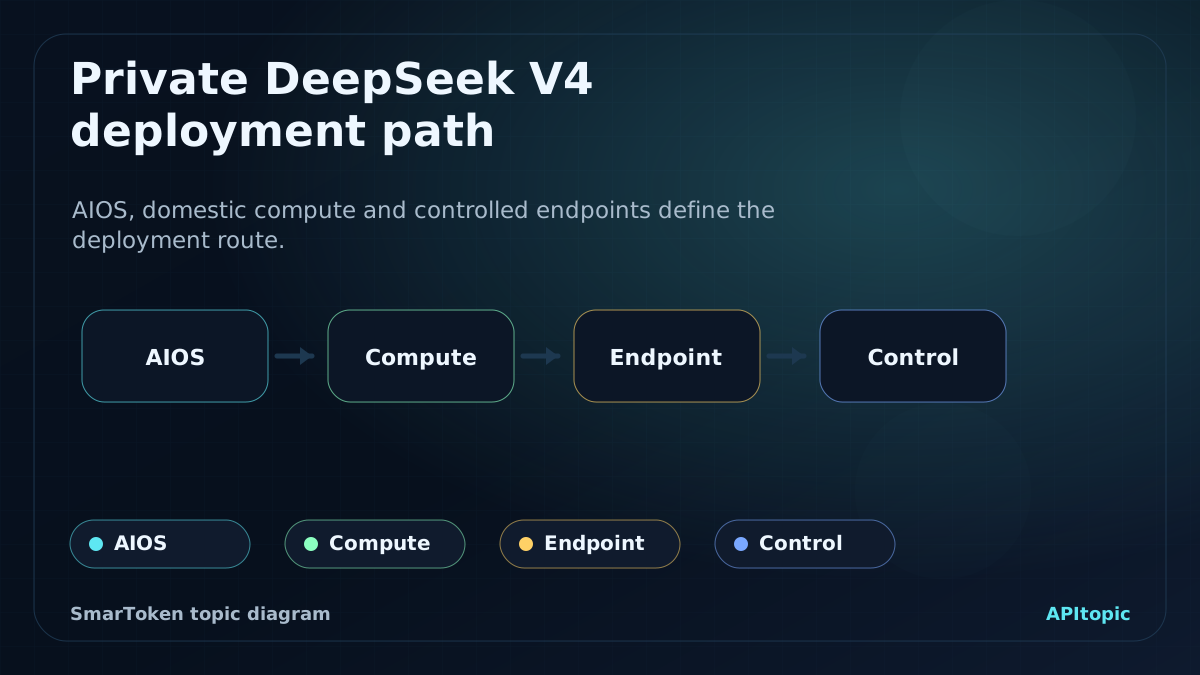
SmarToken editorial diagram for Private DeepSeek V4 deployment path: AIOS, Compute, Endpoint, Control.
Private-deployment diagram for understanding how DeepSeek V4 can move through AIOS and internal infrastructure.
  • Data stays inside the enterprise boundary.
  • Compute, model and operations layers all matter.
  • V4-Flash is a practical first deployment target.
LayerRoleEnterprise check
ComputeHeterogeneous GPU scheduling and fine-grained allocation.Validate GPU compatibility and utilization.
ModelOne-click deployment, long-context optimization and RAG.Test latency, context and knowledge-base quality.
OperationsTenancy, metering, sensitive-data detection and auditing.Check governance and compliance workflows.
AppsDify and FastGPT-style integration.Run a real internal app pilot.

DeepSeek V4 raises the private-serving bar

DeepSeek V4's Pro and Flash variants, 1M context and efficiency improvements as reasons private deployment is now attractive.

A private platform must handle more than one benchmark prompt. Long context increases memory and storage pressure. MoE inference needs parallelism and scheduling. Tool and RAG apps add governance. DeepSeek V4 makes private deployment more valuable, but also more demanding.

  • Capacity-plan for long context.
  • Test both Pro and Flash lanes.
  • Track KV-cache, storage and network pressure.

The three-step demo is a pilot, not a production plan

This page walks through downloading V4-Flash, creating an inference service and testing or integrating the endpoint.

That is a useful starting path. It is not the full production plan. Before live use, teams still need authentication, logging, role-based access, red-team prompts, cost tracking, backups, fallback models and incident response. The page positions the demo as a first proof of life.

  • Use V4-Flash for initial validation.
  • Add access control and logging before wider use.
  • Measure throughput under realistic concurrency.

Domestic compute support is strategic but needs testing

AIOS supports domestic AI chips and mixed deployments, which is important for regulated industries and procurement constraints.

This is strategically important, especially for finance, government, energy and healthcare buyers. But model support on a hardware family is not enough. Teams need to test actual throughput, precision, driver maturity, framework compatibility and support response under their workloads.

  • Benchmark on the target hardware.
  • Check framework and driver versions.
  • Keep a fallback plan during migration.

The last mile is internal application delivery

The central point is that private platforms turn open model releases into usable internal AI applications.

That is the right enterprise framing. The model is only the base. The business value comes when internal teams can build search, support, coding, document and data-analysis apps safely. For practical use, measure usage, task success, compliance review and operating cost after deployment.

  • Pilot with one internal workflow.
  • Measure task completion and user adoption.
  • Expand only after governance is proven.

Common mistakes to avoid

Mistake

Treating one article as a final ranking

Why it hurts

Model releases, pricing, quotas and benchmark positions can change quickly.

Better move

Use the analysis as a shortlist, then run current checks against your own workload.

Mistake

Choosing by brand instead of task

Why it hurts

A strong chat model may still be weak for long documents, coding agents, multimodal work or low-latency routes.

Better move

Define the job first, then compare models with prompts, files or media that match that job.

Mistake

Copying claims without a current verification check

Why it hurts

Benchmark numbers, context windows, API names and prices may be dated or provider-specific.

Better move

Confirm high-impact details against official docs, model cards or live provider pages.

Read it as a model briefing, not a setup guide

View model catalog ->

Use this page to understand the model family, the evaluation angle and the current conversation around it. Then choose one or two realistic prompts, documents or media tasks and test whether the model behaves well in your own workflow.

FAQ

These questions reflect recurring reader concerns around Chinese model knowledge, evaluation and fast-moving model releases.

What is the main point of ZStack AIOS and DeepSeek V4: private deployment for enterprise AI?

ZStack AIOS supports DeepSeek V4-Pro and V4-Flash for private deployment, including domestic AI-chip support and enterprise controls. This page reads the release as a private-AI deployment checklist: compute scheduling, model serving, long-context optimization, RAG, operations, multi-tenancy and compliance matter as much as model capability.

How should readers use the Chinese model context here?

Use it as market and product context, then verify technical claims, pricing, quotas and release details against official pages or your own tests before making a decision.

Why is there a short video with the page?

The video gives a fast visual summary of the model story, while the written page carries the caveats, comparisons and practical checks.

References and verification

SmarToken tracks public model releases, technical reports, product announcements and market signals to keep this catalog useful.

Technical claims need to be treated as dated unless they are confirmed by current official model cards, technical reports or provider announcements.

Pricing, quota, availability and benchmark details can change after the review date, so production decisions should use current vendor pages and direct workload tests.

Get API Key