DeepSeek V4: Flash, Pro, 1M context and open infrastructure
DeepSeek V4 is positioned as an infrastructure-model release. Both V4-Flash and V4-Pro are described as supporting 1M context, while Flash targets low-latency high-frequency use and Pro targets stronger reasoning, coding and agent tasks. The practical takeaway is route design: use Flash for cheap fast calls, Pro for high-value work and verify long-context grounding before replacing RAG.
Key takeaways
01DeepSeek V4 is best read as a practical infrastructure release: Flash and Pro lanes, 1M context, open weights and broad API compatibility.
02The strongest The practical angle is routing: Flash for fast affordable work, Pro for harder reasoning, coding and agent tasks.
03Long context is valuable, but teams should verify grounding before replacing retrieval systems or changing architecture.
DeepSeek V4: Flash, Pro, 1M context and open infrastructure video guide. A short SmarToken video for DeepSeek V4: Flash, Pro, 1M Context And Open Infrastructure, focused on model knowledge, evaluation angles and practical takeaways.
DeepSeek V4 is presented as an infrastructure model
DeepSeek V4 preview ships as V4-Flash and V4-Pro, both with 1M context, open weights, technical documentation and API access.
That combination matters because it gives developers route choices instead of one expensive default. Flash is described as the fast, low-cost lane for high-frequency calls. Pro is described as the stronger lane for reasoning, coding, long context and agent workflows. V4 is presented as an API architecture decision: which lane should handle which work?
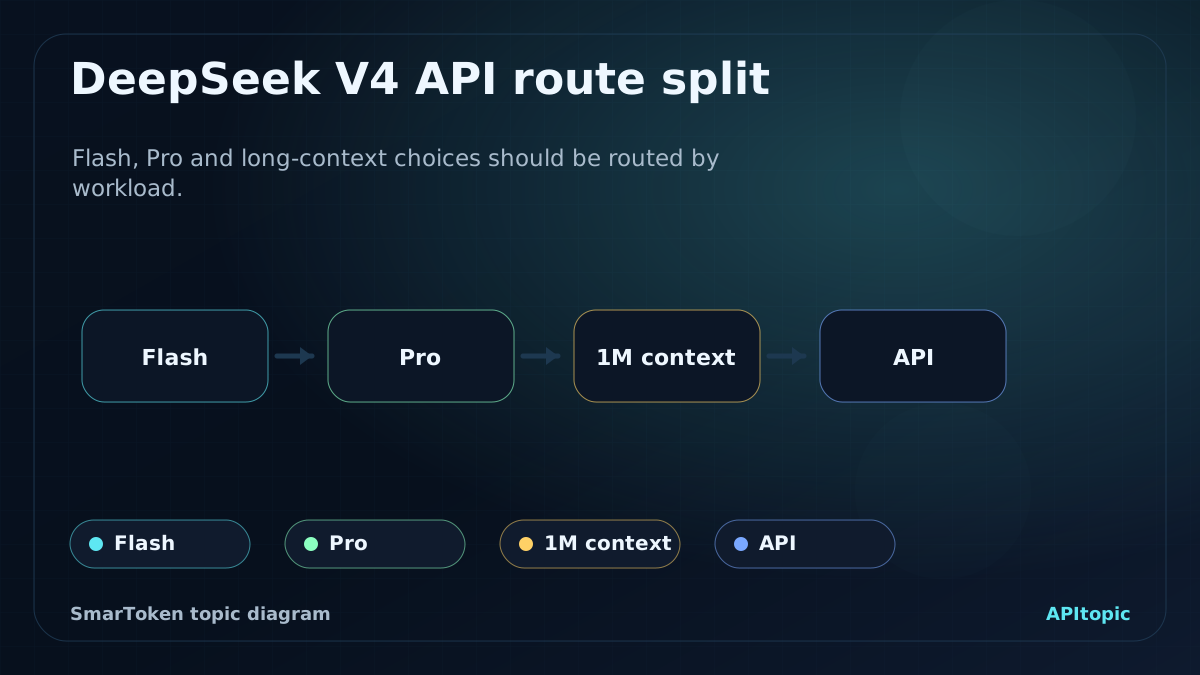
API-routing diagram for deciding between DeepSeek V4 Flash, Pro and long-context usage.
Use Flash for routine or latency-sensitive calls.
Use Pro for high-value reasoning and agent coding.
Keep long-context tests separate from normal chat tests.
Lane
Role
Best first test
V4-Flash
Low-latency and cost-efficient usage.
High-volume chat, function calling and simple extraction.
V4-Pro
Higher capability for hard tasks.
Coding, long documents, complex reasoning and agent workflows.
1M context
Default long-window capability.
Needle-in-document and codebase grounding tests.
Open weights
Inspectable and deployable route.
Local serving, quantization and compatibility checks.
1M context changes architecture, but not automatically
The central point is that 1M context lets developers load codebases, documents, project archives or long books directly into a model call.
That can simplify some RAG-heavy systems, but only if the model actually uses the right context. Large windows can hide misses. Developers should create known-answer tests, ask the model to cite the relevant location and compare full-context calls with retrieval-augmented routes. The goal is not maximum tokens. The goal is reliable use of the right tokens.
Run known-answer long-context tests.
Ask for cited evidence or file locations.
Compare cost with retrieval-based designs.
Flash and Pro should be routed by risk
The Flash/Pro split gives teams a natural routing policy: fast cheap calls go to Flash, higher-risk work goes to Pro.
That routing policy keeps costs under control without throwing quality away. A product can send classification, short extraction and routine responses to Flash, then reserve Pro for code changes, complex synthesis, long-context reasoning and final review. For practical use, measure route-level quality instead of model-level prestige.
Route by task risk, not brand excitement.
Log fallback cases from Flash to Pro.
Track cost per successful workflow.
Open weights turn API claims into deployment tests
DeepSeek V4 weights and tooling are open across common model and serving ecosystems, including mainstream inference and agent frameworks.
That openness is meaningful because teams can inspect, serve and adapt the model. It also creates new work: local deployment, quantization, serving configuration, safety review and compatibility testing. Treat open weights as an opportunity to verify claims, not as proof that deployment will be easy.
Compare official API with self-hosted output.
Validate vLLM or TGI serving behavior.
Review model safety and tool permissions before production.
Migration needs a small harness
old model names will map to new V4 behavior for a transition period before being retired.
That is an operational issue. Even when an API base URL stays stable, model changes can alter latency, style, tool calling, JSON formatting and cost. Before switching production traffic, build a small harness with representative prompts, tool calls, long documents and expected outputs. Then compare old and new routes side by side.
Test model-name mapping before the deadline.
Compare tool calls and JSON output.
Roll out by workflow, not all traffic at once.
Common mistakes to avoid
Mistake
Treating one article as a final ranking
Why it hurts
Model releases, pricing, quotas and benchmark positions can change quickly.
Better move
Use the analysis as a shortlist, then run current checks against your own workload.
Mistake
Choosing by brand instead of task
Why it hurts
A strong chat model may still be weak for long documents, coding agents, multimodal work or low-latency routes.
Better move
Define the job first, then compare models with prompts, files or media that match that job.
Mistake
Copying claims without a current verification check
Why it hurts
Benchmark numbers, context windows, API names and prices may be dated or provider-specific.
Better move
Confirm high-impact details against official docs, model cards or live provider pages.
Turn the article into a short test plan: pick realistic prompts, compare outputs against one or two alternative model families and record quality, latency and cost before choosing a route.
FAQ
These questions reflect recurring reader concerns around Chinese model knowledge, evaluation and fast-moving model releases.
What is the main point of DeepSeek V4: Flash, Pro, 1M context and open infrastructure?
DeepSeek V4 is positioned as an infrastructure-model release. Both V4-Flash and V4-Pro are described as supporting 1M context, while Flash targets low-latency high-frequency use and Pro targets stronger reasoning, coding and agent tasks. The practical takeaway is route design: use Flash for cheap fast calls, Pro for high-value work and verify long-context grounding before replacing RAG.
How should readers use the Chinese model context here?
Use it as market and product context, then verify technical claims, pricing, quotas and release details against official pages or your own tests before making a decision.
Why is there a short video with the page?
The video gives a fast visual summary of the model story, while the written page carries the caveats, comparisons and practical checks.
References and verification
SmarToken tracks public model releases, technical reports, product announcements and market signals to keep this catalog useful.
Technical claims need to be treated as dated unless they are confirmed by current official model cards, technical reports or provider announcements.
Pricing, quota, availability and benchmark details can change after the review date, so production decisions should use current vendor pages and direct workload tests.