DeepSeek V4 technical report: 484 days of architecture work
DeepSeek V4 through two main stories: 1M context made open and efficient, and an architecture stack built to make that possible. The key technical pieces are mHC for stable residual flow, hybrid compressed attention for long context, Muon as a main optimizer, and a training pipeline that openly describes both elegant methods and messy engineering compromises.
Key takeaways
01DeepSeek V4 is best read as an architecture story: 1M context, compressed attention, stable residual flow and a new optimizer stack.
02The most useful practical framing is not hype, but how several engineering choices work together to make long context cheaper and training more stable.
03The report is valuable because it describes both clean ideas and practical compromises, including training instability and memory-heavy distillation.
DeepSeek V4 technical report: 484 days of architecture work video guide. A short SmarToken video for DeepSeek V4 Technical Report: 484 Days Of Architecture Work, focused on model knowledge, evaluation angles and practical takeaways.
The report has two main stories
DeepSeek V4 matters for two reasons: 1M context is now open and more efficient, and the architecture report explains how DeepSeek tried to make that scale stable enough to train and cheap enough to run.
This is the right way to read the release. The public reaction may focus on hype, but this page quickly narrows the technical frame. V4 Pro and V4 Flash both support 1M context. The report claims a large reduction in per-token FLOPs and KV cache compared with the prior long-context route. It also places the model inside a wider hardware and open-source story. Keep both parts visible: public significance and engineering mechanism.
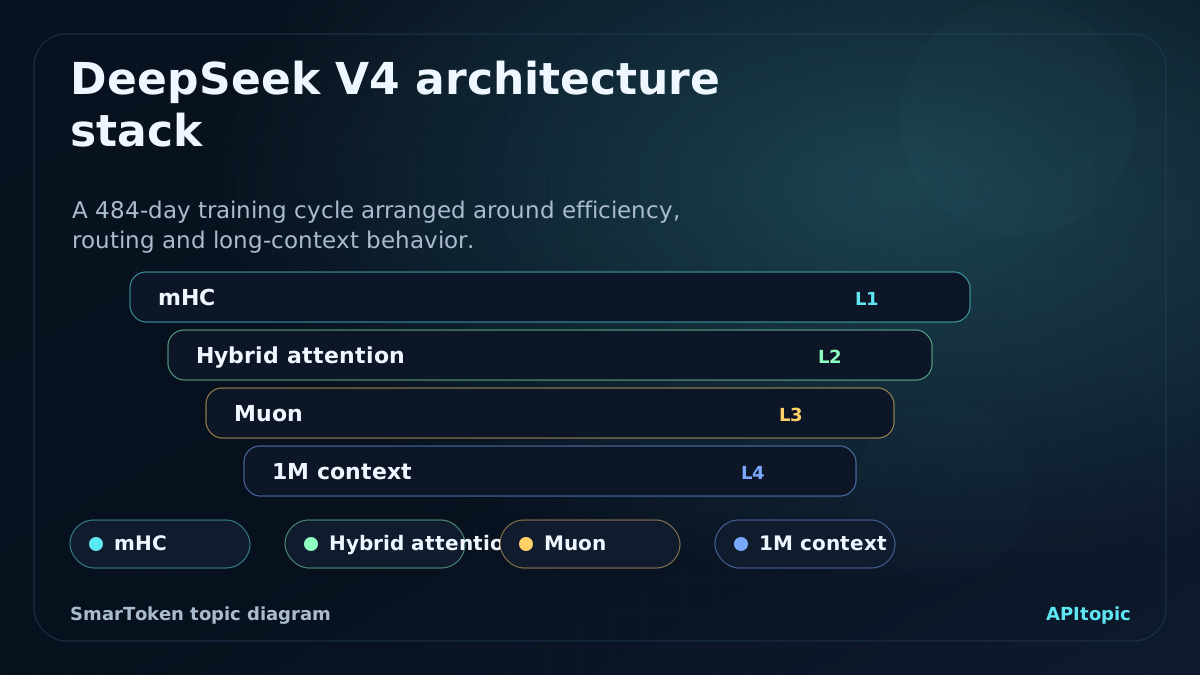
Technical stack diagram summarizing the main DeepSeek V4 design signals discussed in this guide.
1M context is the product-facing headline.
Efficiency is the deployment-facing headline.
Open technical detail is what makes the report worth reading.
Technical piece
Plain meaning
Why readers should care
mHC
A constrained residual-mixing method.
Helps very deep models pass signals more stably.
CSA / HCA
Two compressed attention patterns.
Makes long context cheaper than full attention.
Muon
A matrix-focused optimizer.
Shows large MoE training moving beyond default AdamW.
mHC is a stability patch with strategic importance
mHC adds constraints to hyper-connections so residual signals can be mixed without letting very deep networks become numerically unstable.
mHC as an engineering answer to a familiar scaling problem. Residual connections help deep networks train, but at very large depth and scale the signal path can still become unstable. Hyper-connections add multiple residual streams, but that also adds a matrix that can misbehave. DeepSeek constrains that matrix to a doubly stochastic manifold, keeping rows and columns normalized. In plain language: the model gets more flexible signal mixing, but with guardrails.
mHC is about stable signal flow, not user-facing features.
The constraint keeps the mixing matrix bounded.
The cost is managed with fused kernels and recomputation.
Hybrid attention is the long-context engine
The report's long-context mechanism alternates compressed sparse attention and heavily compressed attention. One preserves selected detail; the other carries broad global signal.
The technical explanation is dense, but the intuition is clear. Full attention over 1M tokens is too expensive. CSA compresses token blocks, selects the most relevant compressed blocks and attends over that smaller set. HCA compresses more aggressively and performs dense attention over the compressed memory. Alternating the two gives the model a way to keep details without paying full attention cost on every token.
This page points out that DeepSeek uses Muon as a main optimizer for most matrix parameters, after Kimi helped prove Muon could work at large MoE scale.
This part is useful because it shows technical ideas moving across teams. Kimi used MuonClip to train a large MoE without collapse. DeepSeek uses Muon too, but with its own hybrid Newton-Schulz iteration and without the same QK-Clip dependency. The reason is architectural: V4 normalizes query and KV entries before attention, reducing the risk of exploding logits at another point in the stack. Same optimizer family, different engineering path.
Muon optimizes 2D matrix parameters.
Other parameters still use AdamW.
DeepSeek and Kimi solve stability pressure differently.
The training story is candid about compromise
The report describes a large training increase, a staged context curriculum and practical workarounds for instability and memory-heavy distillation.
V4 consumes far more pretraining data than V3 and stretches sequence length in stages from short contexts toward 1M. Sparse attention is not enabled from the first token; the system warms up before adding sparsity. The report also admits a serious loss spike and names two workarounds whose deeper mechanism remains an open question. That candor matters. It reminds readers that frontier-scale training is not only elegant math; it is also debugging under extreme memory and stability constraints.
Sequence length grows in stages.
Sparse attention is introduced after warmup.
Loss spikes and workarounds are part of the engineering record.
What readers should take away
Readers should understand DeepSeek V4 as an engineering stack for efficient long context and agent-ready capability, not as a magic single breakthrough.
This is valuable because it explains how several mechanisms fit together. mHC helps stability. Hybrid attention helps 1M context. Muon changes the optimization stack. Training and OPD explain how domain specialists are folded back into one student model. None of these pieces alone proves product fit. Together, they explain why V4 deserves serious evaluation for long-context, coding and agent workflows.
Test long-context grounding, not only max window size.
Test coding and agent tasks with real tool loops.
Keep claims dated because DeepSeek's next release may change the map again.
Common mistakes to avoid
Mistake
Treating one article as a final ranking
Why it hurts
Model releases, pricing, quotas and benchmark positions can change quickly.
Better move
Use the analysis as a shortlist, then run current checks against your own workload.
Mistake
Choosing by brand instead of task
Why it hurts
A strong chat model may still be weak for long documents, coding agents, multimodal work or low-latency routes.
Better move
Define the job first, then compare models with prompts, files or media that match that job.
Mistake
Copying claims without a current verification check
Why it hurts
Benchmark numbers, context windows, API names and prices may be dated or provider-specific.
Better move
Confirm high-impact details against official docs, model cards or live provider pages.
Turn the article into a short test plan: pick realistic prompts, compare outputs against one or two alternative model families and record quality, latency and cost before choosing a route.
FAQ
These questions reflect recurring reader concerns around Chinese model knowledge, evaluation and fast-moving model releases.
What is the main point of DeepSeek V4 technical report: 484 days of architecture work?
DeepSeek V4 through two main stories: 1M context made open and efficient, and an architecture stack built to make that possible. The key technical pieces are mHC for stable residual flow, hybrid compressed attention for long context, Muon as a main optimizer, and a training pipeline that openly describes both elegant methods and messy engineering compromises.
How should readers use the Chinese model context here?
Use it as market and product context, then verify technical claims, pricing, quotas and release details against official pages or your own tests before making a decision.
Why is there a short video with the page?
The video gives a fast visual summary of the model story, while the written page carries the caveats, comparisons and practical checks.
References and verification
SmarToken tracks public model releases, technical reports, product announcements and market signals to keep this catalog useful.
Technical claims need to be treated as dated unless they are confirmed by current official model cards, technical reports or provider announcements.
Pricing, quota, availability and benchmark details can change after the review date, so production decisions should use current vendor pages and direct workload tests.