DigitalOcean DeepSeek V3.2 inference speed: what the engineering claims mean
DigitalOcean Serverless Inference reached very high output speed for DeepSeek V3.2 on Artificial Analysis, with 230 tokens per second at 10K input tokens and sub-second TTFT. The useful Reading is engineering, not just leaderboard heat: hardware, NVFP4 quantization, vLLM tuning, kernel fusion, speculative decoding and customer workload economics all have to work together.
Key takeaways
01This page is a provider-side engineering page about fast serverless inference, not an independent model-quality review.
02The useful claims center on TTFT, output speed, vLLM optimization, NVFP4 quantization, speculative decoding and production economics.
03Keep Artificial Analysis and customer-performance numbers as reported and turn them into a benchmark checklist for readers.
DigitalOcean DeepSeek V3.2 inference speed: what the engineering claims mean video guide. A short SmarToken video for DigitalOcean DeepSeek V3.2 Inference Speed: What The Engineering Claims Mean, focused on model knowledge, evaluation angles and practical takeaways.
This page is really about inference engineering
The analysis says DigitalOcean reached leading output-speed results for DeepSeek V3.2 and related open models by tuning the full inference stack, not by relying on GPUs alone.
That is the useful The practical angle. Inference speed is now a product feature because agents, copilots and voice interfaces chain many model calls together. This page reports 230 output tokens per second for DeepSeek V3.2 with 10K input tokens and TTFT below one second. Those numbers matter only when they survive a reader's own workload, but the engineering pattern is broadly useful.
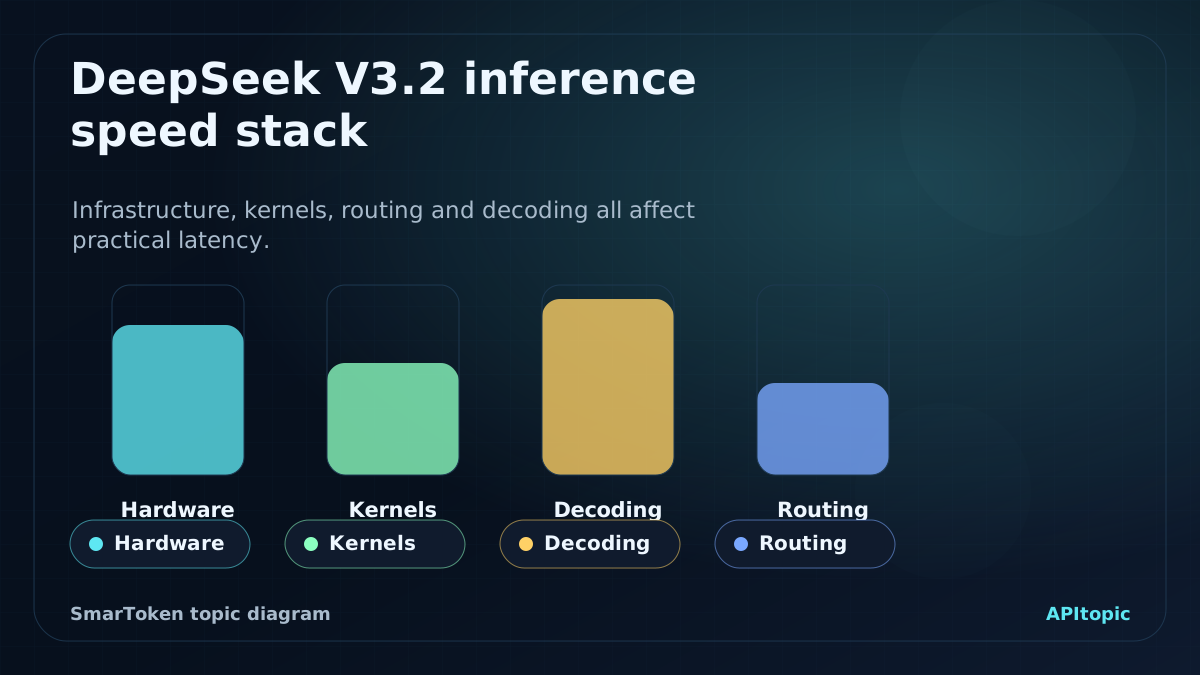
Inference-speed diagram separating the infrastructure and serving layers behind DeepSeek V3.2 latency claims.
Measure TTFT, TPOT and total task time separately.
Use provider benchmarks as a shortlist signal.
Retest speed and quality with your prompt lengths and regions.
Layer
Reported claim
Reader check
Hardware
NVIDIA HGX B300 and Blackwell Ultra capacity.
Check region, GPU class and availability.
Quantization
NVFP4 reduces memory and improves throughput.
Compare quality with non-quantized output.
Serving
Optimized vLLM, tensor parallelism and kernel fusion.
Test concurrency and long-prompt latency.
Decoding
Speculative decoding and MTP improve generation speed.
Watch acceptance rate and output quality.
Fast inference matters because agents stack delays
The central point is that modern AI applications no longer make one model call. Agents may make dozens of sequential calls, so small delays become visible product lag.
This is the most practical part of the page. A chat answer can tolerate some streaming delay. A voice interface, coding agent or business automation task cannot feel stalled at every step. For readers, the correct metric is not only raw tokens per second. It is total time to a useful result, including tool calls, retries and final validation.
Benchmark multi-call agent tasks.
Record total wall-clock completion time.
Compare speed with error rate and retry count.
The benchmark results need workload context
This page cites Artificial Analysis results for DeepSeek V3.2, MiniMax-M2.5 and Qwen 3.5 397B, including high output speed and favorable latency-speed placement.
Those results are valuable, but they are not a universal guarantee. Output speed changes with prompt length, output length, batch size, concurrency, region, model variant and provider load. Keep the benchmark date and model version visible, then encourage teams to reproduce the shape of the test with their own prompts.
Keep the benchmark date attached to the claim.
Match prompt length and output length.
Run tests during expected traffic windows.
The software stack is the differentiator
DigitalOcean tuned vLLM with tensor parallelism, kernel fusion, programmatic dependent launch and speculative decoding.
That list explains why inference is no longer a simple hardware purchase. Large models need memory, GPU interconnects and scheduler choices that fit the workload. Kernel fusion reduces launch overhead. Programmatic dependent launch hides short-kernel tail effects. Speculative decoding uses a draft path to propose tokens and the main model to verify them. Each technique can improve speed, but each also needs quality checks.
Check whether speed gains change answer quality.
Review serving configuration per model family.
Separate low-concurrency interactive tests from batch throughput tests.
Use customer claims as prompts for your own test plan
A Workato customer example with lower latency and lower inference cost on DigitalOcean's platform.
Customer examples are helpful because they show the target outcome: faster first token, lower end-to-end latency and lower cost. They are not a substitute for testing. readers should turn the case study into a checklist: define a representative automation workflow, run it across providers, measure quality, latency and cost, then decide whether switching infrastructure actually improves the product.
Use a representative automation workflow.
Compare provider cost per completed task.
Track support, availability and failure behavior.
Common mistakes to avoid
Mistake
Treating one article as a final ranking
Why it hurts
Model releases, pricing, quotas and benchmark positions can change quickly.
Better move
Use the analysis as a shortlist, then run current checks against your own workload.
Mistake
Choosing by brand instead of task
Why it hurts
A strong chat model may still be weak for long documents, coding agents, multimodal work or low-latency routes.
Better move
Define the job first, then compare models with prompts, files or media that match that job.
Mistake
Copying claims without a current verification check
Why it hurts
Benchmark numbers, context windows, API names and prices may be dated or provider-specific.
Better move
Confirm high-impact details against official docs, model cards or live provider pages.
Turn the article into a short test plan: pick realistic prompts, compare outputs against one or two alternative model families and record quality, latency and cost before choosing a route.
FAQ
These questions reflect recurring reader concerns around Chinese model knowledge, evaluation and fast-moving model releases.
What is the main point of DigitalOcean DeepSeek V3.2 inference speed: what the engineering claims mean?
DigitalOcean Serverless Inference reached very high output speed for DeepSeek V3.2 on Artificial Analysis, with 230 tokens per second at 10K input tokens and sub-second TTFT. The useful Reading is engineering, not just leaderboard heat: hardware, NVFP4 quantization, vLLM tuning, kernel fusion, speculative decoding and customer workload economics all have to work together.
How should readers use the Chinese model context here?
Use it as market and product context, then verify technical claims, pricing, quotas and release details against official pages or your own tests before making a decision.
Why is there a short video with the page?
The video gives a fast visual summary of the model story, while the written page carries the caveats, comparisons and practical checks.
References and verification
SmarToken tracks public model releases, technical reports, product announcements and market signals to keep this catalog useful.
Technical claims need to be treated as dated unless they are confirmed by current official model cards, technical reports or provider announcements.
Pricing, quota, availability and benchmark details can change after the review date, so production decisions should use current vendor pages and direct workload tests.