
APItopic
Model explainer7 min read/Updated 2026-05-25

Qwen3.6-35B-A3B: a sparse MoE coding agent model

Qwen3.6-35B-A3B is presented as a small-active-parameter MoE model aimed at agentic coding and multimodal tasks. It has 35B total parameters and about 3B active parameters, supports thinking and non-thinking modes, and is released through Qwen Studio, Hugging Face, ModelScope and Bailian API as qwen3.6-flash. This page reads it as an efficiency story: sparse activation can make strong coding agents cheaper to run.
Key takeaways

  1. 01Qwen3.6-35B-A3B is presented as an efficient open MoE model with only about 3B active parameters.
  2. 02The main The practical angle is active-parameter efficiency for agentic coding and multimodal reasoning.
  3. 03The model should be evaluated in real coding-agent tools, not only through benchmark screenshots.
Qwen3.6-35B-A3B: a sparse MoE coding agent model video guide. A short SmarToken video for Qwen3.6-35B-A3B: A Sparse MoE Coding Agent Model, focused on model knowledge, evaluation angles and practical takeaways.

The model is small where serving cost is paid

Qwen3.6-35B-A3B has 35B total parameters but only about 3B active parameters per token, as reported here.

That is the central efficiency story. Sparse MoE models can keep a larger pool of capacity while activating only part of it for each token. For coding agents, this matters because tool loops can call the model many times. Lower active compute can reduce cost and latency if quality holds.

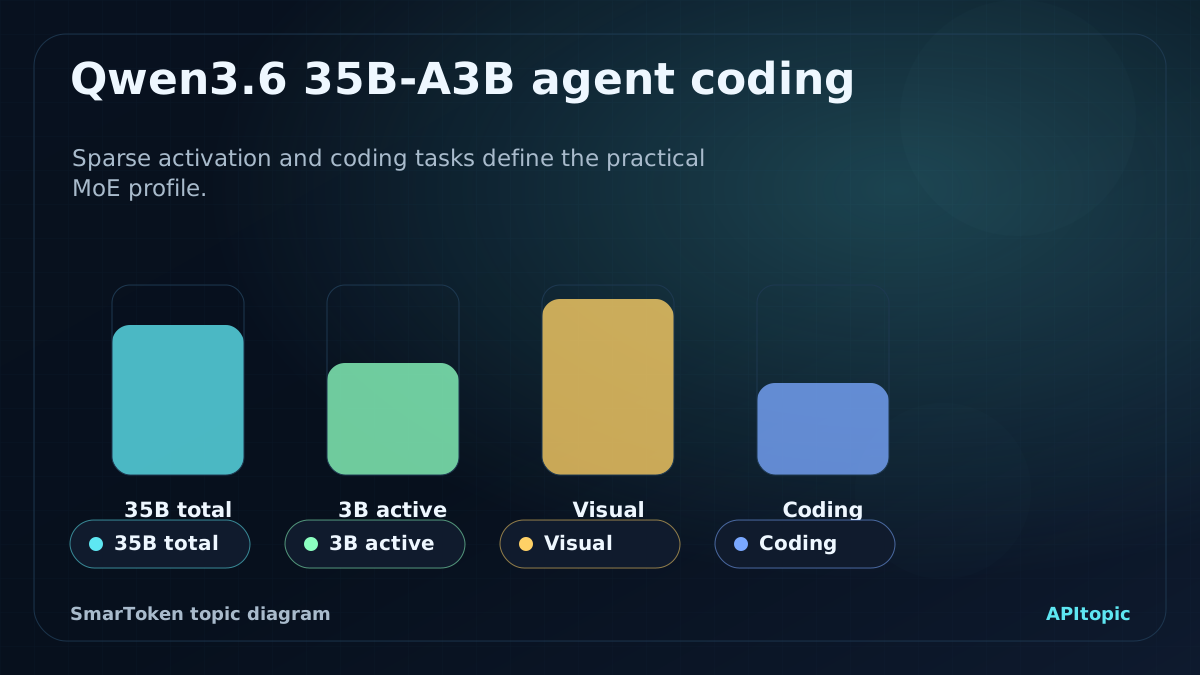
SmarToken editorial diagram for Qwen3.6 35B-A3B agent coding: 35B total, 3B active, Visual, Coding.
MoE diagram for reading Qwen3.6 35B-A3B by active parameters, visual input and coding tasks.
  • Measure active-parameter efficiency through real calls.
  • Compare against dense models at similar quality.
  • Track latency across multi-step coding tasks.
FeatureReported claimValidation step
35B/3B MoELarge total capacity with small active compute.Measure latency and cost.
Agentic codingStrong coding-agent behavior.Run repository tasks with tests.
MultimodalStrong perception and reasoning.Test screenshots, charts and spatial tasks.
Open accessQwen Studio, ModelScope, Hugging Face and Bailian API.Compare local and API routes.

Agentic coding is the first serious test

Qwen3.6-35B-A3B improves sharply over its predecessor in coding-agent and reasoning tasks.

Coding-agent evaluation should use real repositories. Ask the model to read files, make a patch, run tests and explain the change. Then inspect the diff. A coding benchmark is a useful signal, but repository friction reveals whether the model can work inside a living codebase.

  • Use a repository with tests.
  • Inspect all diffs before merging.
  • Track repair loops and failed tool calls.

Multimodal support expands the task surface

the model has strong visual-language perception and reasoning despite its small active-parameter footprint.

That could be valuable for coding agents that read screenshots, UI mockups or diagrams. It also matters for operations, QA and data analysis tasks. For practical use, mix text and visual prompts in evaluation because visual capability can be impressive in benchmarks but brittle on real screenshots.

  • Test UI screenshots and design references.
  • Ask for visual evidence in the answer.
  • Compare visual answers against ground truth.

Preserve thinking changes agent continuity

the release supports preserve_thinking for agent tasks, keeping prior thinking content across turns.

For applications, this is a routing and governance choice. Preserving reasoning may help long tasks stay coherent, but it can also increase context cost and needs careful handling. Developers should decide when to preserve, summarize or discard intermediate reasoning-like content.

  • Use preserve_thinking only for long agent tasks.
  • Measure context cost and quality improvement.
  • Define what is stored and who can inspect it.

Open weights make independent validation easier

Qwen3.6-35B-A3B is available through Hugging Face, ModelScope, Qwen Studio and Bailian API.

That access pattern is helpful. Teams can try the hosted product, test the API and run local or private experiments. But each route may behave differently because serving configuration matters. For practical use, use a small harness that compares hosted, API and self-hosted behavior before adoption.

  • Compare Qwen Studio, Bailian API and local serving.
  • Test OpenClaw, Qwen Code and Claude Code-compatible flows.
  • Promote routes only after cost and quality pass.

Common mistakes to avoid

Mistake

Treating one article as a final ranking

Why it hurts

Model releases, pricing, quotas and benchmark positions can change quickly.

Better move

Use the analysis as a shortlist, then run current checks against your own workload.

Mistake

Choosing by brand instead of task

Why it hurts

A strong chat model may still be weak for long documents, coding agents, multimodal work or low-latency routes.

Better move

Define the job first, then compare models with prompts, files or media that match that job.

Mistake

Copying claims without a current verification check

Why it hurts

Benchmark numbers, context windows, API names and prices may be dated or provider-specific.

Better move

Confirm high-impact details against official docs, model cards or live provider pages.

Read it as a model briefing, not a setup guide

View model catalog ->

Use this page to understand the model family, the evaluation angle and the current conversation around it. Then choose one or two realistic prompts, documents or media tasks and test whether the model behaves well in your own workflow.

FAQ

These questions reflect recurring reader concerns around Chinese model knowledge, evaluation and fast-moving model releases.

What is the main point of Qwen3.6-35B-A3B: a sparse MoE coding agent model?

Qwen3.6-35B-A3B is presented as a small-active-parameter MoE model aimed at agentic coding and multimodal tasks. It has 35B total parameters and about 3B active parameters, supports thinking and non-thinking modes, and is released through Qwen Studio, Hugging Face, ModelScope and Bailian API as qwen3.6-flash. This page reads it as an efficiency story: sparse activation can make strong coding agents cheaper to run.

How should readers use the Chinese model context here?

Use it as market and product context, then verify technical claims, pricing, quotas and release details against official pages or your own tests before making a decision.

Why is there a short video with the page?

The video gives a fast visual summary of the model story, while the written page carries the caveats, comparisons and practical checks.

References and verification

SmarToken tracks public model releases, technical reports, product announcements and market signals to keep this catalog useful.

Technical claims need to be treated as dated unless they are confirmed by current official model cards, technical reports or provider announcements.

Pricing, quota, availability and benchmark details can change after the review date, so production decisions should use current vendor pages and direct workload tests.

Get API Key