Qwen3.5: native multimodal agent architecture for developers
Qwen3.5 as a native multimodal agent model, starting with Qwen3.5-397B-A17B open weights. Its main story is a hybrid architecture that combines Gated Delta Networks with sparse MoE, activates 17B parameters per forward pass out of 397B total, expands language coverage to 201 languages and scales RL environments for agent ability. This page reads it as an infrastructure release for multimodal developers, not only a chat-model update.
Key takeaways
01Qwen3.5 is presented as a native multimodal agent model rather than a narrow text model release.
02The key technical story is 397B total parameters with 17B active, hybrid Gated Delta Networks and sparse MoE, expanded language coverage and RL environment scaling.
03This makes the developer angle clear: Qwen3.5 is about multimodal grounding, long context, tools and agent workflows.
Qwen3.5: native multimodal agent architecture for developers video guide. A short SmarToken video for Qwen3.5: Native Multimodal Agent Architecture For Developers, focused on model knowledge, evaluation angles and practical takeaways.
Qwen3.5 is positioned as a native multimodal agent model
Qwen3.5 through Qwen3.5-397B-A17B, an open-weight vision-language model that combines reasoning, coding, agent ability and multimodal understanding.
The important phrase is native multimodal. Qwen's page says text and vision are trained together early, rather than attaching a visual module to a text-only model at the end. That matters for agents because many useful tasks mix text, images, video, code and tool results. Frame Qwen3.5 as an infrastructure release for developers building these workflows.
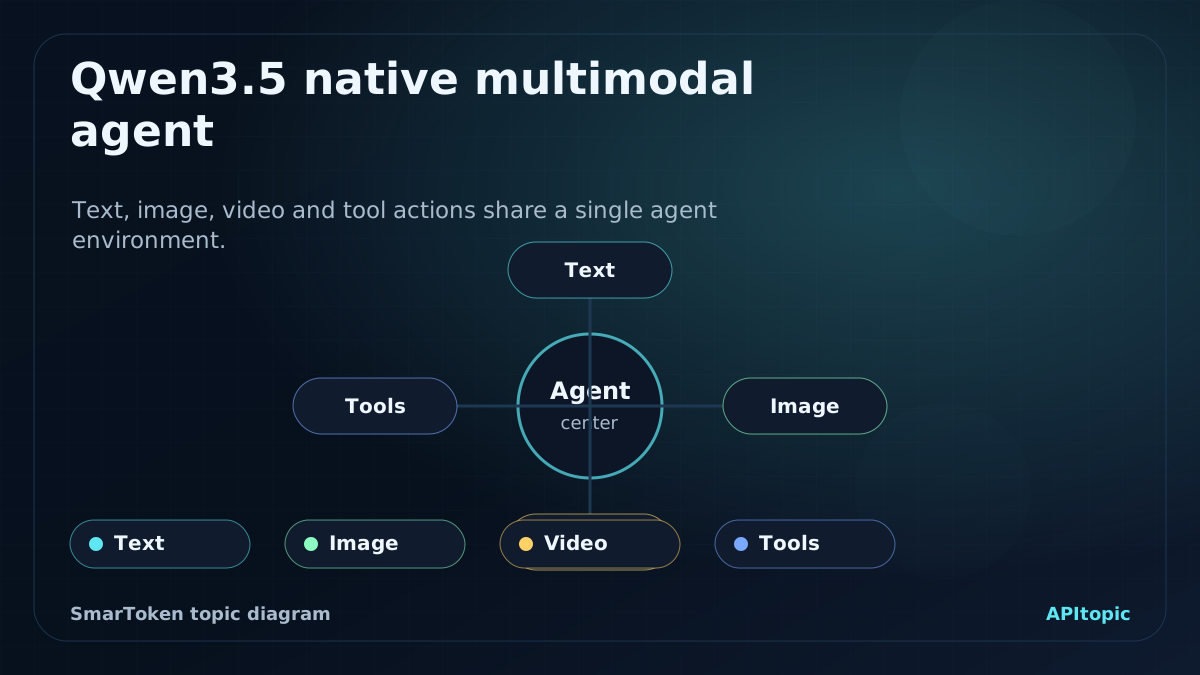
Multimodal agent diagram showing the input and tool lanes that matter when evaluating Qwen3.5.
397B total parameters with about 17B active per forward pass.
Vision-language capability is part of the base story.
Agent, coding and multimodal tasks are evaluated together.
Layer
Reported claim
Why it matters
Architecture
Gated Delta Networks plus sparse MoE.
Improves efficiency while keeping capability.
Language
201 languages and dialects.
Expands global product reach.
Agent RL
Scaled environments for tool and planning tasks.
Makes agent behavior more general, not only benchmark-tuned.
The architecture story is about capability per active parameter
Qwen3.5 combines a high-parameter MoE model with only 17B active parameters per pass, then uses hybrid attention and efficiency work to improve throughput.
That distinction helps readers avoid a common mistake. Total parameters describe capacity; active parameters describe the compute used for a single token path. Qwen3.5's promise is to keep broad capability while making inference more efficient than a dense model of comparable headline size. This page also says the vocabulary grew, which can improve tokenization efficiency across languages.
Do not compare only total parameter counts.
Test latency and cost at 32K, 256K or the context length you need.
Check multilingual tokenization for your real languages.
RL environment scaling is the agentability signal
Qwen's page says post-training gains come from scaling diverse RL environments rather than overfitting narrow query categories.
For developers, this is more important than a single benchmark table. Agent work requires planning, tool use, recovery and multi-turn interaction across changing environments. If RL environments are broad and hard enough, the model may generalize better to real workflows. Still, teams should testing with your own tools because environment scaling does not guarantee behavior in every product surface.
Test planning, tool calls and recovery from mistakes.
Use multi-turn tasks, not only one-shot prompts.
Score task completion and traceability together.
The infrastructure section explains why training multimodal agents is hard
decoupled parallel strategies, sparse activation, FP8 training paths and asynchronous RL infrastructure as the systems work behind Qwen3.5.
This matters because native multimodal training is not just model architecture. It is also a data and systems problem. Text, image and video workloads do not stress hardware in the same way. Qwen's page says its infrastructure keeps mixed-data throughput high and supports large-scale agent environments with better utilization, routing and failure recovery. This makes the plain-language point: reliable agents require training systems that can survive messy, long-running interaction.
Multimodal batches need specialized parallelism.
FP8 saves memory only when sensitive layers are protected.
Agent RL needs rollout routing, recovery and consistency control.
The best first tests are multimodal workflows
Qwen3.5 should be evaluated on tasks that combine perception, reasoning and action: visual coding, GUI operation, long-video understanding, search and code tools.
examples around web development, OpenClaw integration, Qwen Code, GUI agents, visual programming, image reasoning, spatial understanding and visual reasoning. These are exactly the tests that separate a native multimodal agent from a strong text chatbot. A team should build a prompt pack that includes screenshots, long documents, video clips, code tasks and tool calls, then score whether Qwen3.5 can keep the task coherent across modalities.
Use screenshots and videos, not only text prompts.
Include tool calls such as search and code execution.
Check whether the final artifact is useful, not merely descriptive.
Common mistakes to avoid
Mistake
Treating one article as a final ranking
Why it hurts
Model releases, pricing, quotas and benchmark positions can change quickly.
Better move
Use the analysis as a shortlist, then run current checks against your own workload.
Mistake
Choosing by brand instead of task
Why it hurts
A strong chat model may still be weak for long documents, coding agents, multimodal work or low-latency routes.
Better move
Define the job first, then compare models with prompts, files or media that match that job.
Mistake
Copying claims without a current verification check
Why it hurts
Benchmark numbers, context windows, API names and prices may be dated or provider-specific.
Better move
Confirm high-impact details against official docs, model cards or live provider pages.
Turn the article into a short test plan: pick realistic prompts, compare outputs against one or two alternative model families and record quality, latency and cost before choosing a route.
FAQ
These questions reflect recurring reader concerns around Chinese model knowledge, evaluation and fast-moving model releases.
What is the main point of Qwen3.5: native multimodal agent architecture for developers?
Qwen3.5 as a native multimodal agent model, starting with Qwen3.5-397B-A17B open weights. Its main story is a hybrid architecture that combines Gated Delta Networks with sparse MoE, activates 17B parameters per forward pass out of 397B total, expands language coverage to 201 languages and scales RL environments for agent ability. This page reads it as an infrastructure release for multimodal developers, not only a chat-model update.
How should readers use the Chinese model context here?
Use it as market and product context, then verify technical claims, pricing, quotas and release details against official pages or your own tests before making a decision.
Why is there a short video with the page?
The video gives a fast visual summary of the model story, while the written page carries the caveats, comparisons and practical checks.
References and verification
SmarToken tracks public model releases, technical reports, product announcements and market signals to keep this catalog useful.
Technical claims need to be treated as dated unless they are confirmed by current official model cards, technical reports or provider announcements.
Pricing, quota, availability and benchmark details can change after the review date, so production decisions should use current vendor pages and direct workload tests.