Alibaba Cloud Bailian model catalog: what the platform covers
This is a catalog-style overview of what Alibaba Cloud Bailian supports. It lists Qwen, Wanxiang, DeepSeek, Kimi, GLM, Llama, Baichuan and MiniMax-style access, then groups capabilities by text generation, multimodal, image, speech, video, embeddings and industry models. This page reads it as a platform taxonomy rather than a model ranking.
Key takeaways
01This is a catalog page for Alibaba Cloud Bailian model coverage, not a neutral benchmark or deep technical review.
02Its useful contribution is taxonomy: text, multimodal, image, speech, video, embedding and industry model categories.
03The page turns the list into a decision map and warn readers to check official docs for current model names, pricing and quotas.
Alibaba Cloud Bailian model catalog: what the platform covers video guide. A short SmarToken video for Alibaba Cloud Bailian Model Catalog: What The Platform Covers, focused on model knowledge, evaluation angles and practical takeaways.
Bailian is best understood as a model platform taxonomy
Alibaba Cloud Bailian supports Alibaba models such as Qwen and Wanxiang plus third-party model families, organized across text, image, speech, video, embeddings and industry tasks.
That taxonomy is useful for teams choosing where to build. A platform decision often starts with modality: text generation, visual understanding, image creation, voice, video, embeddings or industry-specific tools. Readers can map a task to a model category before comparing prices or SDKs.
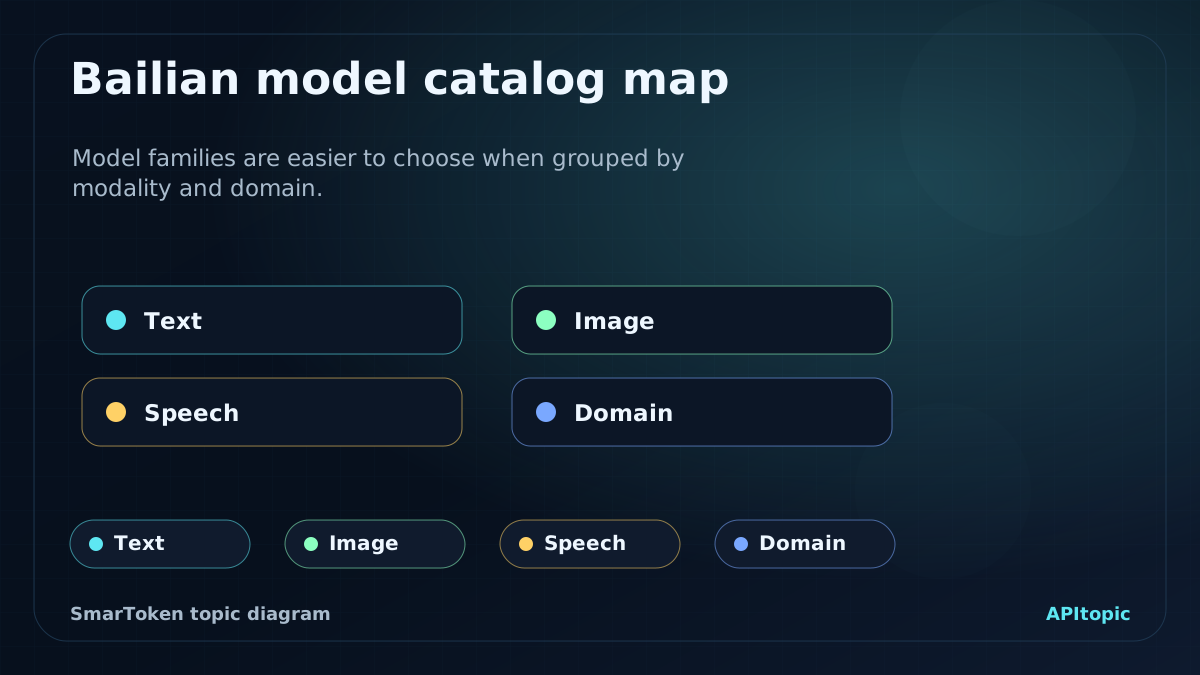
Catalog diagram for scanning Aliyun Bailian models by modality, embeddings and domain-specific use.
Start with the task modality.
Then choose model family and route.
Finally verify current docs, quotas and pricing.
Category
Examples
What to test
Text
Qwen, DeepSeek, Kimi, GLM and other LLMs.
Structured output, long context and latency.
Image
Qwen image, Wanxiang, FLUX and editing tools.
Text rendering, edits and rights.
Speech
TTS, ASR and translation models.
Latency, language accuracy and noise handling.
Video
Text-to-video, image-to-video and editing.
Motion quality, prompt control and cost.
Text generation is only one part of the catalog
This page splits text-related access into general LLMs, multimodal models and domain models such as code, math, legal or intent understanding.
That matters because teams often say they need an LLM when they actually need a task-specific route. A coding assistant, legal reader and general chatbot may all sit under text generation, but their evaluation criteria differ. For practical use, start with the output contract, not the model name.
Define the output contract first.
Use domain models when the task is narrow.
Compare general and domain routes on the same inputs.
Image and video models need usage-right checks
text-to-image, image editing, product imagery, virtual models, video generation and video editing model categories.
These are high-impact categories for marketing and ecommerce. They also need stronger review. Generated assets need checking for brand safety, copyright risk, human likeness risk, text accuracy and commercial usage terms. A model catalog is not enough to prove that an output can be published.
Check commercial-use terms.
Review generated text and human likenesses.
Keep source and prompt records for publishable assets.
Speech and embedding routes are infrastructure choices
speech synthesis, speech recognition, translation and embedding models for search, clustering, recommendation and classification.
These models often sit inside larger products where small errors scale. For speech, test accents, noise and real-time latency. For embeddings, test retrieval quality, recall, vector cost and index behavior. This makes clear that these routes need product-shaped evaluation, not only API availability.
Measure speech latency and word error rate.
Evaluate embeddings with real search queries.
Track cost across ingestion and retrieval.
The catalog must be refreshed before buying guidance
many models and quotas, but cloud platform catalogs change quickly. Do not freeze those details as permanent advice.
This is the main editorial caution. Platform pages, free quotas, model IDs and supported features can change month to month. The page can remain useful as a category guide, but any current pricing, quota or model-name claim needs checking against official Bailian documentation before production use.
Refresh model names and quotas.
Check official docs before publishing.
Keep the page as a task-category map.
Common mistakes to avoid
Mistake
Treating one article as a final ranking
Why it hurts
Model releases, pricing, quotas and benchmark positions can change quickly.
Better move
Use the analysis as a shortlist, then run current checks against your own workload.
Mistake
Choosing by brand instead of task
Why it hurts
A strong chat model may still be weak for long documents, coding agents, multimodal work or low-latency routes.
Better move
Define the job first, then compare models with prompts, files or media that match that job.
Mistake
Copying claims without a current verification check
Why it hurts
Benchmark numbers, context windows, API names and prices may be dated or provider-specific.
Better move
Confirm high-impact details against official docs, model cards or live provider pages.
Turn the article into a short test plan: pick realistic prompts, compare outputs against one or two alternative model families and record quality, latency and cost before choosing a route.
FAQ
These questions reflect recurring reader concerns around Chinese model knowledge, evaluation and fast-moving model releases.
What is the main point of Alibaba Cloud Bailian model catalog: what the platform covers?
This is a catalog-style overview of what Alibaba Cloud Bailian supports. It lists Qwen, Wanxiang, DeepSeek, Kimi, GLM, Llama, Baichuan and MiniMax-style access, then groups capabilities by text generation, multimodal, image, speech, video, embeddings and industry models. This page reads it as a platform taxonomy rather than a model ranking.
How should readers use the Chinese model context here?
Use it as market and product context, then verify technical claims, pricing, quotas and release details against official pages or your own tests before making a decision.
Why is there a short video with the page?
The video gives a fast visual summary of the model story, while the written page carries the caveats, comparisons and practical checks.
References and verification
SmarToken tracks public model releases, technical reports, product announcements and market signals to keep this catalog useful.
Technical claims need to be treated as dated unless they are confirmed by current official model cards, technical reports or provider announcements.
Pricing, quota, availability and benchmark details can change after the review date, so production decisions should use current vendor pages and direct workload tests.