
APItopic
Evaluation8 min read/Updated 2026-05-25

MiniMax M2.7 evaluation: self-evolution and engineering delivery

The central point is that MiniMax M2.7 is no longer just a generation model. Its main claim is self-evolution: analyze failed paths, plan changes, execute, verify and iterate. The hands-on tests show better engineering completeness than M2.5 in logic, SVG generation, Three.js simulation and system-style UI tasks. This page reads it as a low-cost first-tier candidate that still needs task-specific verification.
Key takeaways

  1. 01This page frames MiniMax M2.7 as a model moving from generation toward closed-loop engineering execution.
  2. 02The most important claim is self-evolution: repeated analysis, planning, execution, verification and correction.
  3. 03the result is treated as promising but not final; generated simulations and UI demos still need to be run and inspected.
MiniMax M2.7 evaluation: self-evolution and engineering delivery video guide. A short SmarToken video for MiniMax M2.7 Evaluation: Self-Evolution And Engineering Delivery, focused on model evaluation, tradeoffs and the current discussion.

M2.7 is presented as a closed-loop model

MiniMax M2.7's main shift is self-evolution: the model can analyze failed paths, plan improvements, execute changes and verify again instead of stopping after one output.

That is the release's practical promise. Many models can generate code, text or UI on the first try. The harder problem is getting closer to a deliverable artifact through iteration. The central point is that M2.7 is better at that loop than M2.5, especially in engineering-like tasks where correctness, structure and polish all matter.

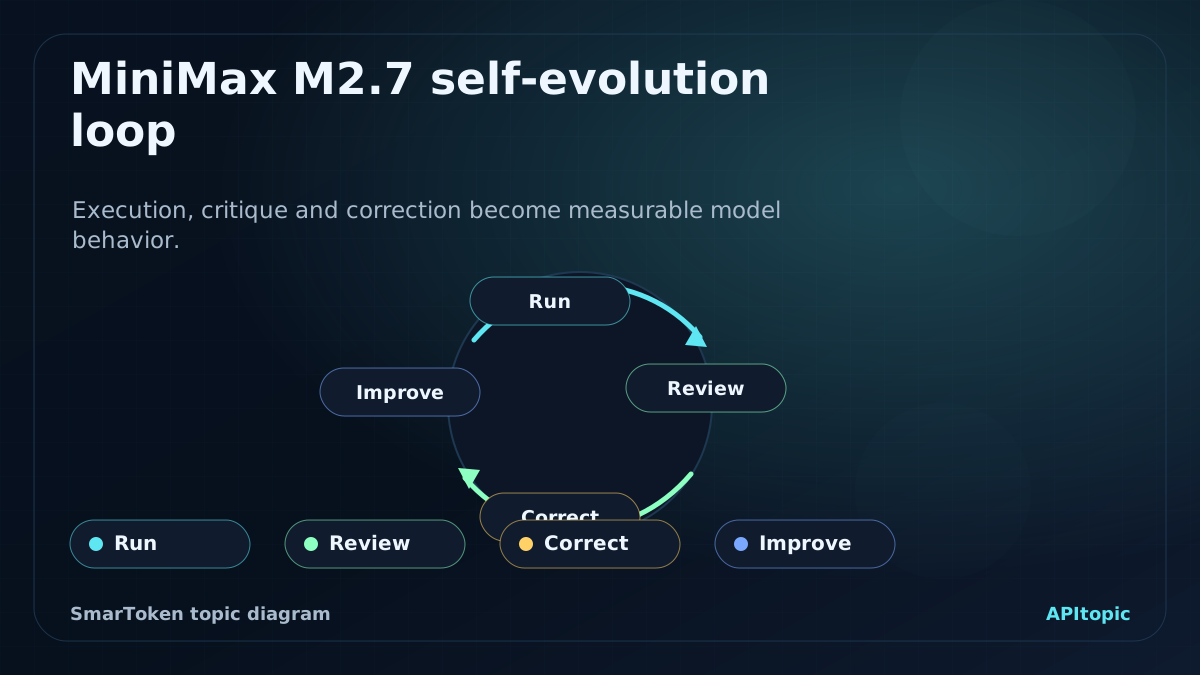
SmarToken editorial diagram for MiniMax M2.7 self-evolution loop: Run, Review, Correct, Improve.
Self-evolution loop for reading MiniMax M2.7 as an agent model that improves through execution feedback.
  • Self-evolution should be tested as repeated repair, not just described.
  • The best prompts include failure signals and verification steps.
  • Output quality should be judged after running the artifact.
Test laneWhat this page checksWhat readers should inspect
LogicWhether M2.7 finds all valid paths.Assumptions, missed cases and final answer.
SVGWhether visual semantics and motion fit the prompt.Geometry, animation and physical plausibility.
Three.jsWhether a complex simulator feels complete.Controls, HUD, component logic and frame stability.
Mac UIWhether a system-style interface has usable parts.Windows, menu behavior, icons and interactions.

The model improves most where engineering completeness matters

The examples suggest M2.7 improves not only surface quality, but task completeness: structure, controls, interaction details and multi-part simulation logic.

That is different from writing a nicer paragraph or a cleaner code snippet. Engineering completeness means the model remembers the pieces of the product: layout, controls, state, events, visual feedback and constraints. The V8 engine and Mac UI tests are useful because they expose whether the model can organize a small system, not only generate a pretty first screen.

  • Score functional coverage before visual polish.
  • Use multi-component prompts, not only single widgets.
  • Keep a checklist for missing controls and broken states.

Self-correction still needs external verification

Even if a model can self-review, humans or automated tests must verify the result. This page itself notes remaining defects in visual feedback and physical logic.

This is the healthy reading. A self-evolving model may reduce the number of manual repair loops, but it does not remove the need for tests. Generated SVG can look expressive while its motion is physically wrong. A UI simulation can look complete while a menu or window state fails. For practical use, run external checks for every high-impact output.

  • Run generated code in a controlled environment.
  • Compare against a written acceptance checklist.
  • Use automated tests where possible and manual review where visual judgment matters.

Cost is part of the model's positioning

The central point is that M2.7 is compelling because it approaches first-tier performance at a much lower reported cost than some competitors.

Cost claims are time-sensitive, so Do not freeze them as permanent facts. But the idea is important: route selection should compare cost per completed workflow, not only token price or benchmark score. A cheaper model that needs many repair loops can be expensive. A slightly stronger model that finishes reliably may be cheaper in practice.

  • Measure cost per accepted artifact.
  • Include retries and human review time.
  • Refresh pricing before procurement decisions.

The best use case is a staged engineering test

M2.7 should be tested on staged tasks where it can plan, build, inspect and revise: simulations, interfaces, bug fixes and multi-file project work.

The examples point toward a clear adoption path. Do not start with a mission-critical workflow. Start with a medium-complexity task that has observable requirements. Give the model room to iterate, log what it changes, run the output and compare it with a baseline model. That is how teams can tell whether self-evolution is real value or just release language.

  • Choose a task with measurable success criteria.
  • Allow iterative repair but log each pass.
  • Compare M2.7 with at least one adjacent route.

Common mistakes to avoid

Mistake

Treating one article as a final ranking

Why it hurts

Model releases, pricing, quotas and benchmark positions can change quickly.

Better move

Use the analysis as a shortlist, then run current checks against your own workload.

Mistake

Choosing by brand instead of task

Why it hurts

A strong chat model may still be weak for long documents, coding agents, multimodal work or low-latency routes.

Better move

Define the job first, then compare models with prompts, files or media that match that job.

Mistake

Copying claims without a current verification check

Why it hurts

Benchmark numbers, context windows, API names and prices may be dated or provider-specific.

Better move

Confirm high-impact details against official docs, model cards or live provider pages.

Read it as a model briefing, not a setup guide

View model catalog ->

Use this page to understand the model family, the evaluation angle and the current conversation around it. Then choose one or two realistic prompts, documents or media tasks and test whether the model behaves well in your own workflow.

FAQ

These questions reflect recurring reader concerns around Chinese model knowledge, evaluation and fast-moving model releases.

What is the main point of MiniMax M2.7 evaluation: self-evolution and engineering delivery?

The central point is that MiniMax M2.7 is no longer just a generation model. Its main claim is self-evolution: analyze failed paths, plan changes, execute, verify and iterate. The hands-on tests show better engineering completeness than M2.5 in logic, SVG generation, Three.js simulation and system-style UI tasks. This page reads it as a low-cost first-tier candidate that still needs task-specific verification.

How should readers use the Chinese model context here?

Use it as market and product context, then verify technical claims, pricing, quotas and release details against official pages or your own tests before making a decision.

Why is there a short video with the page?

The video gives a fast visual summary of the model story, while the written page carries the caveats, comparisons and practical checks.

References and verification

SmarToken tracks public model releases, technical reports, product announcements and market signals to keep this catalog useful.

Technical claims need to be treated as dated unless they are confirmed by current official model cards, technical reports or provider announcements.

Pricing, quota, availability and benchmark details can change after the review date, so production decisions should use current vendor pages and direct workload tests.

Get API Key