
APItopic
Model explainer7 min read/Updated 2026-05-25

IQuest-Coder-V1: 40B code model, Loop architecture and SWE-Bench hype

IQuest-Coder-V1 is presented as a surprising open code-model release from Ubiquant, a Beijing quantitative-investment firm. The headline is a 40B model that reports strong SWE-Bench Verified performance, supports 128K context, offers Instruct and Thinking variants, and explores a Loop architecture for better parameter use. The practical reading is cautious: the model looks important, but benchmark claims and demo cases need independent workflow testing.
Key takeaways

  1. 01IQuest-Coder-V1 is presented as an unexpectedly strong open code-model family from Ubiquant-backed IQuest.
  2. 02The important ideas are 7B/14B/40B sizes, Instruct and Thinking routes, 128K context, a Loop variant and code-flow multi-stage training.
  3. 03Keep the excitement but add caution: benchmark wins and interactive demos need sandboxed validation.
IQuest-Coder-V1: 40B code model, Loop architecture and SWE-Bench hype video guide. A short SmarToken video for IQuest-Coder-V1: 40B Code Model, Loop Architecture And SWE-Bench Hype, focused on model knowledge, evaluation angles and practical takeaways.

IQuest-Coder-V1 is interesting because of where it comes from

IQuest-Coder-V1 drew attention because it is a strong open code model from IQuest, linked to Ubiquant, a major Chinese quantitative-investment firm. That makes the release both a model story and an industry story.

The page compares the moment to the way quantitative firms entered large-model training through DeepSeek and now IQuest. That context matters, but it should not replace model evaluation. the company background is treated as one explanation for talent and engineering discipline, while keeping the page focused on what developers can test: coding ability, long context, generated interfaces and deployment footprint.

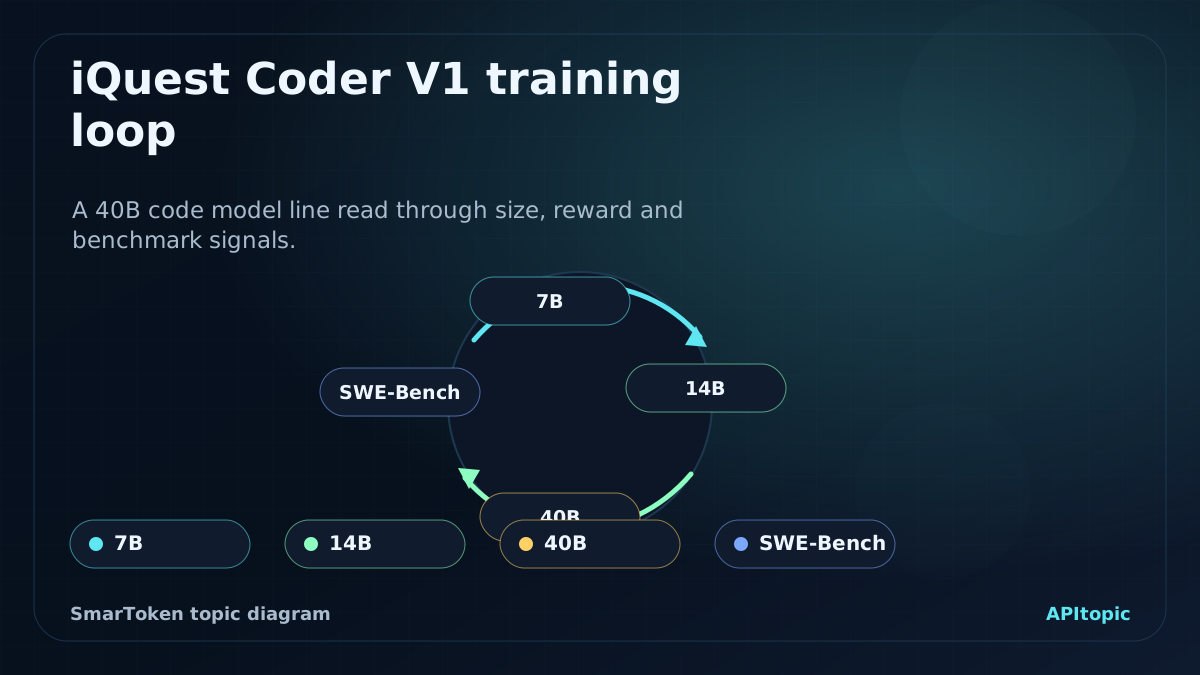
SmarToken editorial diagram for iQuest Coder V1 training loop: 7B, 14B, 40B, SWE-Bench.
Training-loop view of iQuest Coder V1, with model sizes and benchmark positioning separated for quick comparison.
  • Company background explains why the release attracted attention.
  • It does not prove the model's quality by itself.
  • The useful question is what the open weights can do in real workflows.
Model routePositioningWhat to test
InstructEfficient instruction following and engineering use.Bug fixes, refactors and UI generation.
ThinkingSlower route for complex reasoning and decomposition.Multi-step repo tasks and algorithm design.
40B LoopParameter-efficiency experiment with lower memory pressure.Throughput, latency and quality under the same hardware budget.

The architecture is built for code repositories

four architecture choices: grouped-query attention, native 128K context, a 76,800-token vocabulary and a Loop variant with shared parameters.

Those choices point toward software engineering use. Long context helps the model read multiple files. GQA reduces memory pressure during inference. A larger vocabulary can better represent code symbols, paths and identifiers. The Loop variant tries to reuse parameters through repeated computation rather than simply scaling size. These are plausible engineering choices for code, but teams still need direct tests on their own repositories.

  • Use 128K context to test repo-level reasoning.
  • Measure memory and throughput, not only answer quality.
  • Check whether the vocabulary helps with real identifiers and paths.

Code-flow training is the most useful concept

IQuest-Coder uses code-flow multi-stage training, where the model learns from code evolution, not only static code snapshots.

This is the most durable insight in the page. Real software work is about change: old repository state, a patch and the new state after the patch. a triplet structure that lets the model see the lifecycle of code changes, especially in the middle part of a project where engineering patterns are mature but still evolving. That helps explain why the model may do well on software-engineering tasks rather than only coding puzzles.

  • Static code teaches syntax and patterns.
  • Code-flow data teaches change, repair and project evolution.
  • The best evaluation is a repo task with before and after states.

The demos are impressive, but demos are not deployment

interactive examples such as a solar-system simulation, particle text, pixel sandbox, space shooter and flocking simulation. They are useful surface tests, not production proof.

Interactive demos reveal whether a coding model can organize state, animation, controls and visual feedback. They are much better than a static function test. Still, generated demos must be executed and inspected. A page can look impressive while hiding performance issues, edge-case bugs or fragile code. We tell readers to run the output in a sandbox and inspect both interaction and maintainability.

  • Run every generated UI before judging it.
  • Check frame rate, controls and failure cases.
  • Review code structure so the demo can be edited later.

Deployment claims make the model worth a local test

IQuest-Coder includes open releases and smaller deployment options, including quantized routes that may fit consumer GPUs. That makes independent testing more realistic.

This is where an open code model can become useful for developers. If a team can run a 7B, 14B or quantized 40B route locally, it can test private repositories without sending code to a remote service. But local feasibility is not only about fitting in memory. It also depends on context length, latency, tool integration and whether generated code passes tests. The practical conclusion is to create a local evaluation harness before adopting the model.

  • Check license, weights and quantized variants.
  • Run repository tests after generation.
  • Measure latency at the intended context length.

Common mistakes to avoid

Mistake

Treating one article as a final ranking

Why it hurts

Model releases, pricing, quotas and benchmark positions can change quickly.

Better move

Use the analysis as a shortlist, then run current checks against your own workload.

Mistake

Choosing by brand instead of task

Why it hurts

A strong chat model may still be weak for long documents, coding agents, multimodal work or low-latency routes.

Better move

Define the job first, then compare models with prompts, files or media that match that job.

Mistake

Copying claims without a current verification check

Why it hurts

Benchmark numbers, context windows, API names and prices may be dated or provider-specific.

Better move

Confirm high-impact details against official docs, model cards or live provider pages.

Read it as a model briefing, not a setup guide

View model catalog ->

Use this page to understand the model family, the evaluation angle and the current conversation around it. Then choose one or two realistic prompts, documents or media tasks and test whether the model behaves well in your own workflow.

FAQ

These questions reflect recurring reader concerns around Chinese model knowledge, evaluation and fast-moving model releases.

What is the main point of IQuest-Coder-V1: 40B code model, Loop architecture and SWE-Bench hype?

IQuest-Coder-V1 is presented as a surprising open code-model release from Ubiquant, a Beijing quantitative-investment firm. The headline is a 40B model that reports strong SWE-Bench Verified performance, supports 128K context, offers Instruct and Thinking variants, and explores a Loop architecture for better parameter use. The practical reading is cautious: the model looks important, but benchmark claims and demo cases need independent workflow testing.

How should readers use the Chinese model context here?

Use it as market and product context, then verify technical claims, pricing, quotas and release details against official pages or your own tests before making a decision.

Why is there a short video with the page?

The video gives a fast visual summary of the model story, while the written page carries the caveats, comparisons and practical checks.

References and verification

SmarToken tracks public model releases, technical reports, product announcements and market signals to keep this catalog useful.

Technical claims need to be treated as dated unless they are confirmed by current official model cards, technical reports or provider announcements.

Pricing, quota, availability and benchmark details can change after the review date, so production decisions should use current vendor pages and direct workload tests.

Get API Key