
APItopic
Evaluation8 min read/Updated 2026-05-25

DeepSeek V4 Pro evaluation: scenario fit over parameter racing

DeepSeek V4 Pro is best read as a production-fit release, not only a parameter race. The headline claims are 1M context, lower long-context cost, sparse attention, a Pro and Flash split, and stronger agent/coding behavior. The hands-on results are more balanced: V4 Pro looks useful and more polished, but the right conclusion is scenario fit, not automatic victory.
Key takeaways

  1. 01DeepSeek V4 Pro is best read as a serious production candidate because of 1M context, efficiency gains and stronger agent/coding behavior.
  2. 02The hands-on tests are balanced: V4 Pro is improved and useful, but it still shows task-specific weaknesses.
  3. 03The practical angle is scenario fit: choose Pro, Flash or another route based on the workflow, not on release hype.
DeepSeek V4 Pro evaluation: scenario fit over parameter racing video guide. A short SmarToken video for DeepSeek V4 Pro Evaluation: Scenario Fit Over Parameter Racing, focused on model evaluation, tradeoffs and the current discussion.

DeepSeek V4 Pro is a production-fit story

This page does not treat DeepSeek V4 Pro as only a bigger model. It treats the release as an efficiency and workflow story: 1M context, lower long-context compute, sparse attention, stronger agent behavior and a Pro/Flash split for different workloads.

That framing is useful. Many model releases compete by total parameter count or benchmark claims. This page focuses on what developers feel in a workflow: how much context can be passed, how expensive long documents become, whether the model can plan and code, and whether a cheaper Flash route can handle lighter tasks. Keep the page grounded in those questions.

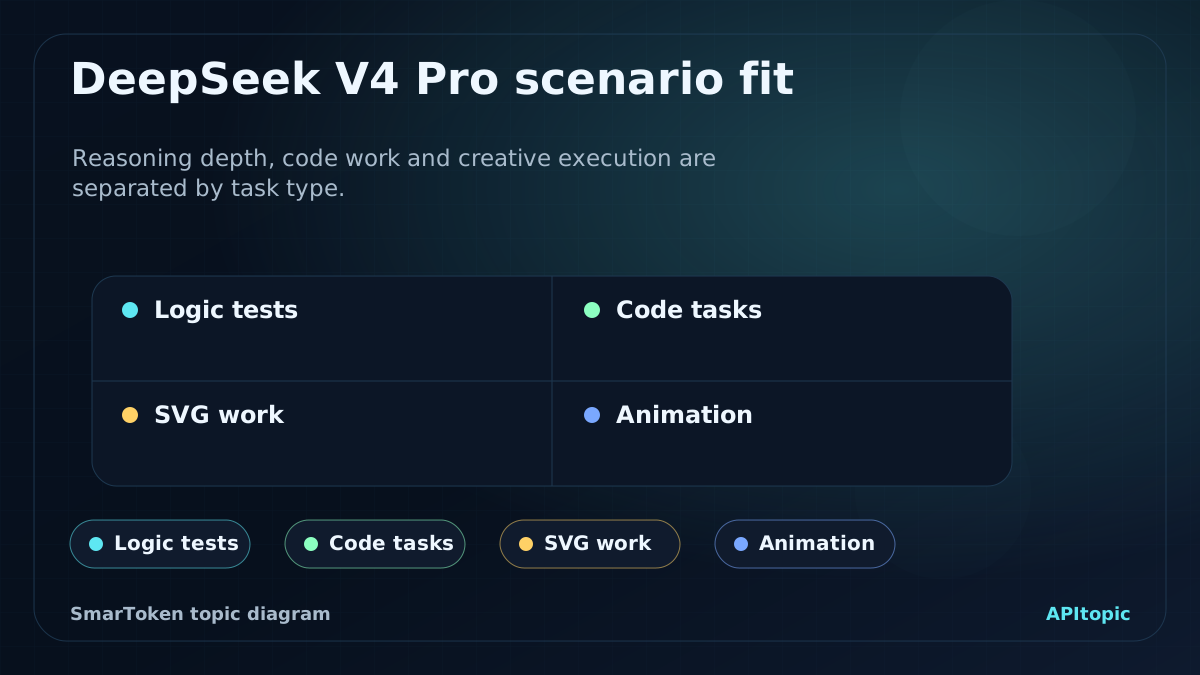
SmarToken editorial diagram for DeepSeek V4 Pro scenario fit: Logic tests, Code tasks, SVG work, Animation.
Scenario matrix for reading DeepSeek V4 Pro as a workload-specific model, not a single universal answer.
  • 1M context changes what can be passed in one call.
  • Efficiency matters because long context can otherwise become too expensive.
  • Pro and Flash should be tested as different route roles.
RoutePositioningBest first test
V4 ProHigher-capability route for difficult reasoning, coding and agent tasks.Complex logic plus coding workflow.
V4 FlashLower-cost and faster route for lighter repeated tasks.High-frequency short tasks and simple agent steps.
Fallback routeAlternative model when V4 behavior misses a constraint.Same prompt pack with strict scoring.

The test setup favors practical tasks

DeepSeek V4 Pro with logic, SVG generation, single-page web design and interactive animation. These tasks expose reasoning, code structure, visual judgment and instruction following.

This is more useful than a single score. A model can be strong at one kind of coding and weak at another. SVG generation tests spatial consistency and animation logic. Web creation tests layout, restraint and requirement coverage. Interactive animation tests whether the model can organize a small system, not only write a visual snippet. These cases help readers understand where V4 Pro feels production-ready and where another route may still be safer.

  • Logic tests reveal shortcut reasoning.
  • SVG tests reveal spatial and animation mistakes.
  • Web tasks reveal design-system consistency.
  • Interactive animation tests system organization.

Reasoning is stable, but not immune to path dependence

The logic example shows that V4 Pro can still lock onto a familiar problem pattern and miss a condition. That is a real production caveat.

This does not make the model weak. It makes the evaluation honest. Strong reasoning models can still choose the wrong analogy, especially when a prompt resembles a classic puzzle but changes a key assumption. For route testing, that means a team should include prompts where the obvious pattern is not enough. If the workflow involves legal, financial, engineering or scientific reasoning, path dependence should be tested directly.

  • Use near-classic prompts with changed assumptions.
  • Ask the model to state which assumptions it is using.
  • Score reasoning path, not only final answer.

Coding quality improved, but output still needs inspection

This page finds clear improvement in coding and visual-generation quality, especially compared with older DeepSeek expectations, but it still flags logic and interaction problems.

The coding examples are useful because they separate first-impression polish from correctness. A generated SVG may look lively while the motion direction is wrong. A portfolio site may feel cleaner while some interaction details are incomplete. In practical terms, the model deserves a real route test, not blind promotion. Developers should inspect whether the generated artifact follows the functional requirement, not only whether it looks more polished than before.

  • Inspect animation and interaction logic.
  • Compare design restraint against the prompt.
  • Run the generated code rather than judging text output only.

The selection lesson is scenario fit

The final conclusion moves away from parameter racing. DeepSeek V4 Pro should be selected when the workflow benefits from long context, stronger coding and agent capability, and acceptable cost.

This is the right page conclusion. A model can be first-tier and still not be the best default for every request. Pro is a candidate for difficult reasoning and code. Flash is a candidate for high-frequency lighter tasks. Other routes may remain better for long-document reading, office workflows or multimodal product surfaces. The decision should be based on the task, not on the release headline.

  • Use Pro for harder reasoning and code.
  • Use Flash for lighter repeated tasks after testing.
  • Keep adjacent routes in the comparison.

Common mistakes to avoid

Mistake

Treating one article as a final ranking

Why it hurts

Model releases, pricing, quotas and benchmark positions can change quickly.

Better move

Use the analysis as a shortlist, then run current checks against your own workload.

Mistake

Choosing by brand instead of task

Why it hurts

A strong chat model may still be weak for long documents, coding agents, multimodal work or low-latency routes.

Better move

Define the job first, then compare models with prompts, files or media that match that job.

Mistake

Copying claims without a current verification check

Why it hurts

Benchmark numbers, context windows, API names and prices may be dated or provider-specific.

Better move

Confirm high-impact details against official docs, model cards or live provider pages.

Read it as a model briefing, not a setup guide

View model catalog ->

Use this page to understand the model family, the evaluation angle and the current conversation around it. Then choose one or two realistic prompts, documents or media tasks and test whether the model behaves well in your own workflow.

FAQ

These questions reflect recurring reader concerns around Chinese model knowledge, evaluation and fast-moving model releases.

What is the main point of DeepSeek V4 Pro evaluation: scenario fit over parameter racing?

DeepSeek V4 Pro is best read as a production-fit release, not only a parameter race. The headline claims are 1M context, lower long-context cost, sparse attention, a Pro and Flash split, and stronger agent/coding behavior. The hands-on results are more balanced: V4 Pro looks useful and more polished, but the right conclusion is scenario fit, not automatic victory.

How should readers use the Chinese model context here?

Use it as market and product context, then verify technical claims, pricing, quotas and release details against official pages or your own tests before making a decision.

Why is there a short video with the page?

The video gives a fast visual summary of the model story, while the written page carries the caveats, comparisons and practical checks.

References and verification

SmarToken tracks public model releases, technical reports, product announcements and market signals to keep this catalog useful.

Technical claims need to be treated as dated unless they are confirmed by current official model cards, technical reports or provider announcements.

Pricing, quota, availability and benchmark details can change after the review date, so production decisions should use current vendor pages and direct workload tests.

Get API Key