
APItopic
Model explainer7 min read/Updated 2026-05-25

MiniMax M2.7: agent harnesses, SRE tasks and self-evolution

This page frames MiniMax M2.7 as a cowork-agent release rather than a normal chat-model update. Its strongest themes are instruction following across many skills, native multi-agent teams, SRE-style debugging, Office workflow execution, role-play memory and the ability to build or improve its own agent harness. This page reads the release as a shift from using tools to shaping the tool environment itself.
Key takeaways

  1. 01MiniMax M2.7 is presented as a cowork-agent model rather than only a stronger chatbot.
  2. 02The core claim is that M2.7 can coordinate agents, debug production-like systems and even improve the harness around itself.
  3. 03Keep benchmark numbers release-focused and focus on the reusable evaluation pattern: multi-agent work, SRE incidents, documents and harness iteration.
MiniMax M2.7: agent harnesses, SRE tasks and self-evolution video guide. A short SmarToken video for MiniMax M2.7: Agent Harnesses, SRE Tasks And Self-Evolution, focused on model knowledge, evaluation angles and practical takeaways.

M2.7 is framed as a cowork-agent release

MiniMax M2.7 improves instruction following, multi-agent collaboration, coding, SRE troubleshooting, Office automation and role-play memory.

That mix matters because it describes a model aimed at work loops, not only one-shot answers. This page repeatedly returns to the same practical question: can the model hold a role, call the right skill, coordinate other agents, inspect logs, write code and deliver a useful artifact? The page preserves that workflow frame and avoids turning the release into a single leaderboard claim.

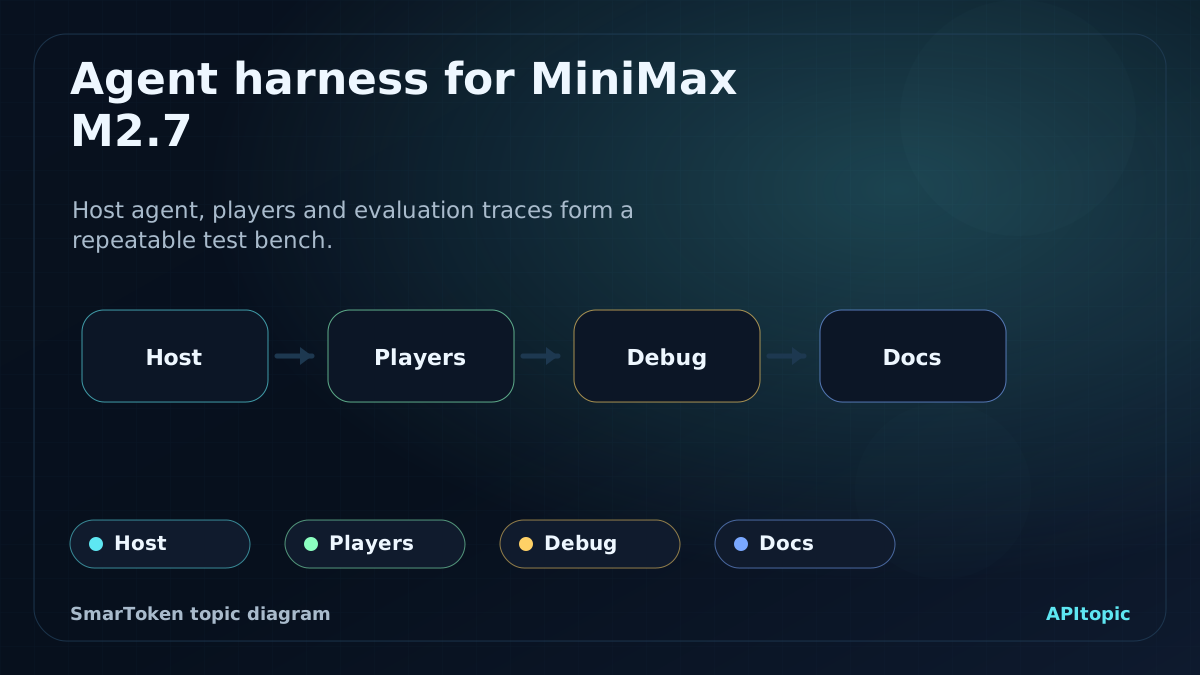
SmarToken editorial diagram for Agent harness for MiniMax M2.7: Host, Players, Debug, Docs.
Agent-harness diagram showing how MiniMax M2.7 can be tested through repeatable role-based tasks.
  • Use the page as a map of agent tasks.
  • Separate reported benchmark results from independent proof.
  • Test the model with real files, tools and review gates.
Core themePlain meaningValidation step
Cowork agentThe model can work with roles and tools.Run a multi-role workflow with checkpoints.
SRE debuggingThe model can inspect incidents and propose fixes.Use a sandboxed outage case with logs.
Office automationThe model can turn documents into reports and slides.Check formulas, citations and layout.
Harness iterationThe model can improve its tool environment.Review code changes and run smoke tests.

The multi-agent example tests more than role play

The game-room test asks M2.7 to coordinate one host agent and five player agents, generate role files and build a visible front-end/back-end workflow.

That is a useful stress test because it combines planning, persona stability, front-end generation, back-end orchestration and long-flow control. A model can sound good in a dialogue and still fail when it must keep several agents, files and UI states aligned. M2.7's demo should therefore be read as an agent-orchestration example, not just a playful role-play case.

  • Check whether roles stay distinct over several turns.
  • Inspect generated files instead of trusting the UI alone.
  • Watch for coordination failures between agents.

SRE debugging is the most production-shaped test

M2.7 can read incident materials, connect logs to database behavior, propose EXPLAIN commands and generate a non-blocking PostgreSQL index fix.

This is the section with the clearest enterprise value. Production debugging requires more than code syntax. The model must infer the failing path, avoid unsafe operations and explain how to verify the fix. the use of CONCURRENTLY for index creation, which is a good sign because it respects a real production constraint: do not lock a hot table during emergency recovery.

  • Run debugging tests in a sandbox.
  • Ask for the direct trigger and the root cause separately.
  • Require rollback, verification and safety notes before merging code.

Office work shows whether agents can finish deliverables

M2.7 can compare annual reports, build revenue models, create Excel pivot tables, write Word reports and generate PPT decks.

This is where agent usefulness becomes visible to non-developers. A business workflow is not complete when the model drafts one paragraph. It is complete when tables, assumptions, document structure and slides line up. For practical use, check every number and citation. The direction is clear: strong models are moving from answer generation toward document production.

  • Verify spreadsheet formulas and assumptions.
  • Check report structure against the reference material.
  • Review slide design and factual consistency.

Self-evolution is the real strategic claim

The central point is that M2.7 can build and improve agent harnesses, using memory, feedback and iterative code changes to make its own work environment better.

This is the most important idea in the page. The industry is busy adapting external harnesses, but the page notes M2.7 moves closer to creating and improving those harnesses itself. If that direction holds up, model competition shifts from tool use to tool construction. The evaluation burden also rises: every self-improvement loop needs tests, logs, approval and a way to detect regressions.

  • Treat self-improvement as code changes, not magic.
  • Keep logs and memory artifacts inspectable.
  • Approve harness updates only after tests pass.

Common mistakes to avoid

Mistake

Treating one article as a final ranking

Why it hurts

Model releases, pricing, quotas and benchmark positions can change quickly.

Better move

Use the analysis as a shortlist, then run current checks against your own workload.

Mistake

Choosing by brand instead of task

Why it hurts

A strong chat model may still be weak for long documents, coding agents, multimodal work or low-latency routes.

Better move

Define the job first, then compare models with prompts, files or media that match that job.

Mistake

Copying claims without a current verification check

Why it hurts

Benchmark numbers, context windows, API names and prices may be dated or provider-specific.

Better move

Confirm high-impact details against official docs, model cards or live provider pages.

Read it as a model briefing, not a setup guide

View model catalog ->

Use this page to understand the model family, the evaluation angle and the current conversation around it. Then choose one or two realistic prompts, documents or media tasks and test whether the model behaves well in your own workflow.

FAQ

These questions reflect recurring reader concerns around Chinese model knowledge, evaluation and fast-moving model releases.

What is the main point of MiniMax M2.7: agent harnesses, SRE tasks and self-evolution?

This page frames MiniMax M2.7 as a cowork-agent release rather than a normal chat-model update. Its strongest themes are instruction following across many skills, native multi-agent teams, SRE-style debugging, Office workflow execution, role-play memory and the ability to build or improve its own agent harness. This page reads the release as a shift from using tools to shaping the tool environment itself.

How should readers use the Chinese model context here?

Use it as market and product context, then verify technical claims, pricing, quotas and release details against official pages or your own tests before making a decision.

Why is there a short video with the page?

The video gives a fast visual summary of the model story, while the written page carries the caveats, comparisons and practical checks.

References and verification

SmarToken tracks public model releases, technical reports, product announcements and market signals to keep this catalog useful.

Technical claims need to be treated as dated unless they are confirmed by current official model cards, technical reports or provider announcements.

Pricing, quota, availability and benchmark details can change after the review date, so production decisions should use current vendor pages and direct workload tests.

Get API Key