
APItopic
Model explainer7 min read/Updated 2026-05-25

GLM-4.7-Flash: MLA, 3B active parameters and local agent use

GLM-4.7-Flash is presented as a lightweight open model for local coding and agent assistants: 30B total parameters, about 3B active parameters, 200K context and first-time GLM use of DeepSeek-style MLA. This page reads it as an efficiency and deployment story: small-active MoE plus MLA can make local and low-cost agent workflows more realistic, but throughput, latency and current pricing still need verification.
Key takeaways

  1. 01GLM-4.7-Flash is presented as a lightweight open coding and agent model: 30B total parameters, about 3B active and 200K context.
  2. 02Its strongest technical angle is first-time GLM use of DeepSeek-style MLA, plus immediate ecosystem support in Hugging Face, vLLM, Ascend and local Mac testing.
  3. 03Keep benchmark, Mac speed and API price details as reported until official docs and current pricing are refreshed.
GLM-4.7-Flash: MLA, 3B active parameters and local agent use video guide. A short SmarToken video for GLM-4.7-Flash: MLA, 3B Active Parameters And Local Agent Use, focused on model knowledge, evaluation angles and practical takeaways.

GLM-4.7-Flash is positioned as a local agent assistant

Zhipu's GLM-4.7-Flash targets local coding and agent assistant workflows, replacing GLM-4.5-Flash and inheriting GLM-4 coding and reasoning ability.

This is the useful reading for developers. The model is not framed as the largest possible GLM release. It is framed as a practical model that can be called cheaply, tested locally and used in coding, translation, long-context and agent tasks.

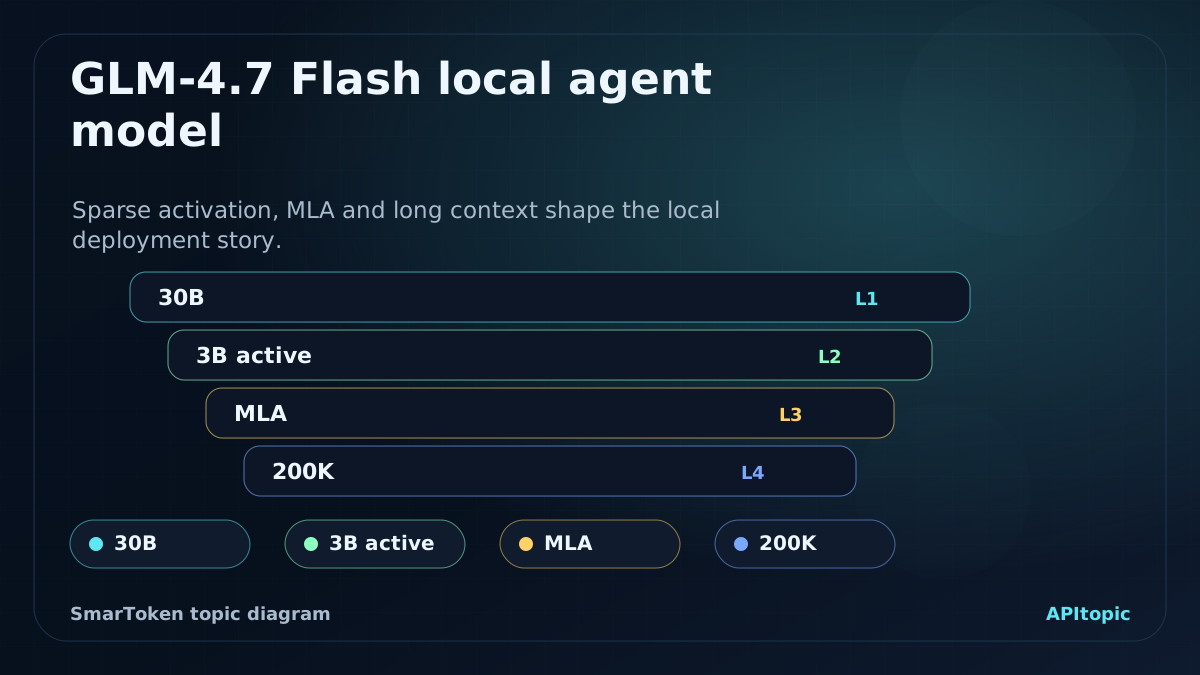
SmarToken editorial diagram for GLM-4.7 Flash local agent model: 30B, 3B active, MLA, 200K.
Local-agent diagram for GLM-4.7 Flash, separating parameter shape, attention design and serving options.
  • Use it for local coding-agent trials.
  • Compare against previous GLM Flash and adjacent MoE models.
  • Do not treat leaderboard claims as deployment proof.
FeatureReported claimValidation step
MoE30B total and about 3B active parameters.Measure latency and cost.
MLAFirst GLM Flash use of DeepSeek-style MLA.Check config and technical report.
Context200K context window.Test long-context grounding.
DeploymentHugging Face, vLLM, Ascend and Mac examples.Benchmark target hardware.

MLA connects the release to the broader efficiency race

Developers noticed GLM-4.7-Flash adopting Multi-head Latent Attention, an architecture associated with DeepSeek.

MLA matters because long-context serving is often limited by cache memory and attention cost. If GLM's implementation reduces KV-cache pressure while keeping quality, the model becomes more practical for local and low-cost agent workflows. Frame this as a hypothesis to test until the full technical report is available.

  • Verify architecture from official configs.
  • Measure long-context memory use.
  • Compare quality at the same context length.

Day-zero ecosystem support lowers adoption friction

quick support from Hugging Face, vLLM and Ascend NPU routes soon after release.

Ecosystem support can matter as much as model quality. If a model loads easily in common serving stacks, developers can test it quickly. The catch is that support is not equal to production maturity. Throughput, quantization, driver versions and serving stability still need checks.

  • Test the exact serving stack.
  • Record driver and quantization settings.
  • Run concurrency and cancellation tests.

Mac local performance is promising but not universal

This page cites a developer report of running the model on a 32GB unified-memory M5 Mac at 43 tokens per second.

That is a useful signal for local experimentation. It should not be converted into a universal performance claim. Local speed depends on quantization, prompt length, memory pressure, software version and workload. Phrase it as a test result to reproduce.

  • Reproduce with the same quantization.
  • Test long prompts and tool loops.
  • Measure sustained speed, not only a short demo.

Free and low-cost API lanes need current checks

the basic GLM-4.7-Flash API lane is free with concurrency limits and that the FlashX lane is very cheap.

Pricing and free quotas change quickly. The page can note the reported launch offer, but any buying guidance should refresh the official API page. The more durable lesson is that Chinese model vendors are using cheap Flash-class models to compete for developer workflows.

  • Refresh official pricing before production use.
  • Check concurrency and rate limits.
  • Compare latency and throughput with price.

Common mistakes to avoid

Mistake

Treating one article as a final ranking

Why it hurts

Model releases, pricing, quotas and benchmark positions can change quickly.

Better move

Use the analysis as a shortlist, then run current checks against your own workload.

Mistake

Choosing by brand instead of task

Why it hurts

A strong chat model may still be weak for long documents, coding agents, multimodal work or low-latency routes.

Better move

Define the job first, then compare models with prompts, files or media that match that job.

Mistake

Copying claims without a current verification check

Why it hurts

Benchmark numbers, context windows, API names and prices may be dated or provider-specific.

Better move

Confirm high-impact details against official docs, model cards or live provider pages.

Read it as a model briefing, not a setup guide

View model catalog ->

Use this page to understand the model family, the evaluation angle and the current conversation around it. Then choose one or two realistic prompts, documents or media tasks and test whether the model behaves well in your own workflow.

FAQ

These questions reflect recurring reader concerns around Chinese model knowledge, evaluation and fast-moving model releases.

What is the main point of GLM-4.7-Flash: MLA, 3B active parameters and local agent use?

GLM-4.7-Flash is presented as a lightweight open model for local coding and agent assistants: 30B total parameters, about 3B active parameters, 200K context and first-time GLM use of DeepSeek-style MLA. This page reads it as an efficiency and deployment story: small-active MoE plus MLA can make local and low-cost agent workflows more realistic, but throughput, latency and current pricing still need verification.

How should readers use the Chinese model context here?

Use it as market and product context, then verify technical claims, pricing, quotas and release details against official pages or your own tests before making a decision.

Why is there a short video with the page?

The video gives a fast visual summary of the model story, while the written page carries the caveats, comparisons and practical checks.

References and verification

SmarToken tracks public model releases, technical reports, product announcements and market signals to keep this catalog useful.

Technical claims need to be treated as dated unless they are confirmed by current official model cards, technical reports or provider announcements.

Pricing, quota, availability and benchmark details can change after the review date, so production decisions should use current vendor pages and direct workload tests.

Get API Key