
APItopic
Model explainer7 min read/Updated 2026-05-25

Zhipu GLM-5 Scaling Pain: KV cache, speculative decoding and agent serving

This page summarizes Zhipu's unusually candid technical post about GLM-5 serving failures under high-load coding-agent traffic. The problem was not simple model quality. It involved inference-state management: KV-cache races in PD-disaggregated serving, read-before-ready timing in HiCache and monitoring signals from speculative decoding. This page reads it as a reminder that scaling intelligence also means scaling the serving system.
Key takeaways

  1. 01This is valuable because it describes real production failures in high-load Coding Agent serving rather than only model benchmark wins.
  2. 02The anomalies point to inference-state bugs: KV-cache races, HiCache read timing and speculative decoding signals.
  3. 03Frame Scaling Pain as a systems lesson: model capability and serving reliability must scale together.
Zhipu GLM-5 Scaling Pain: KV cache, speculative decoding and agent serving video guide. A short SmarToken video for Zhipu GLM-5 Scaling Pain: KV Cache, Speculative Decoding And Agent Serving, focused on model knowledge, evaluation angles and practical takeaways.

The problem was not a normal benchmark failure

GLM-5 users saw rare gibberish, repetition and abnormal-character outputs in complex Coding Agent tasks, but local replay could not reproduce them.

That makes the post important. Many teams assume strange model output means the model weights are weak or the prompt is bad. Zhipu's case points somewhere else: high-load inference state. Under online traffic, timing, cache reuse, prefill/decode separation and speculative decoding can interact in ways that almost never show up in a clean offline test.

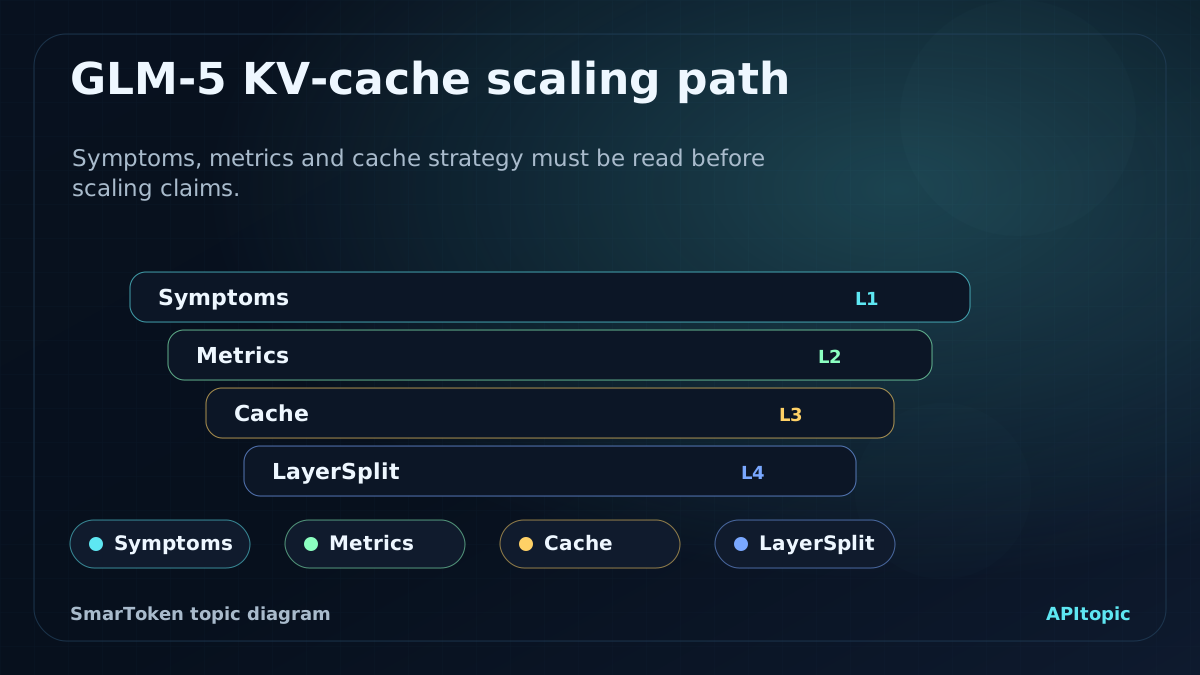
SmarToken editorial diagram for GLM-5 KV-cache scaling path: Symptoms, Metrics, Cache, LayerSplit.
Debugging diagram for reading GLM-5 scaling issues through KV-cache behavior and serving strategy.
  • Reproduce agent failures under load, not only offline replay.
  • Log serving state alongside generated text.
  • Treat rare failures as system signals when traffic is huge.
SymptomTechnical signalEngineering response
GibberishVery low speculative accept length.Abort, retry and inspect KV state.
Rare charactersVery low speculative accept length.Monitor draft-target mismatch.
RepetitionVery high speculative accept rate.Detect degenerate high-confidence loops.
Timing bugsCache reuse before writes or loads finish.Add explicit synchronization.

Speculative decoding became a monitoring signal

abnormal speculative decoding metrics helped identify generation failures before they became long bad outputs.

Speculative decoding is usually discussed as a speed technique. A draft model proposes tokens, and the target model accepts or rejects them. Zhipu's lesson is that the accept pattern can also expose system damage. If the target model rejects almost everything, or accepts too much in a repetitive loop, the serving system may need to stop and retry the request.

  • Track accept length and accept rate.
  • Set abort-and-retry rules for abnormal patterns.
  • Store examples for postmortem analysis.

KV-cache lifecycle caused a race condition

This page attributes one major issue to mismatched request lifecycle and KV-cache recycle timing in a prefill/decode separated architecture.

In plain language, a cache slot could be reused before all writes tied to the previous request were safely complete. That can corrupt the context seen by the next generation step. The reported fix adds explicit synchronization between termination, RDMA writes and safe cache recycling. The broader lesson is simple: cache ownership needs a real lifecycle contract.

  • Do not recycle cache slots before writes are complete.
  • Add explicit safe-reclaim signals.
  • Test cancellation paths, not only happy paths.

HiCache had a read-before-ready timing gap

another issue came from overlapping KV-cache loading with computation without guaranteeing that data was ready before use.

This is the classic systems tradeoff. Overlap improves performance, but only if the dependency is enforced. Zhipu's fix inserts synchronization so the relevant cache is fully loaded before attention computation uses it. For readers, the point is not the product name HiCache. It is the pattern: every performance optimization needs a correctness barrier.

  • Overlap IO and compute only with readiness checks.
  • Audit stream dependencies under load.
  • Run stress tests at long context lengths.

Prefill is becoming the agent-serving bottleneck

long-context Coding Agent workloads make prefill the dominant pressure point, leading Zhipu to design LayerSplit for KV-cache storage and broadcast.

That connects this page to the broader model infrastructure race. Agents create long histories, large files and repeated context reuse. If prefill and KV-cache movement are inefficient, the model may be smart but the product will be slow or unstable. Zhipu's LayerSplit claim needs to be treated as one concrete design response: split cache storage by layers, broadcast what is needed and hide communication behind computation.

  • Measure prefill time separately from decode time.
  • Track cache hit rate and request length distribution.
  • Optimize throughput without weakening output-quality monitoring.

Common mistakes to avoid

Mistake

Treating one article as a final ranking

Why it hurts

Model releases, pricing, quotas and benchmark positions can change quickly.

Better move

Use the analysis as a shortlist, then run current checks against your own workload.

Mistake

Choosing by brand instead of task

Why it hurts

A strong chat model may still be weak for long documents, coding agents, multimodal work or low-latency routes.

Better move

Define the job first, then compare models with prompts, files or media that match that job.

Mistake

Copying claims without a current verification check

Why it hurts

Benchmark numbers, context windows, API names and prices may be dated or provider-specific.

Better move

Confirm high-impact details against official docs, model cards or live provider pages.

Read it as a model briefing, not a setup guide

View model catalog ->

Use this page to understand the model family, the evaluation angle and the current conversation around it. Then choose one or two realistic prompts, documents or media tasks and test whether the model behaves well in your own workflow.

FAQ

These questions reflect recurring reader concerns around Chinese model knowledge, evaluation and fast-moving model releases.

What is the main point of Zhipu GLM-5 Scaling Pain: KV cache, speculative decoding and agent serving?

This page summarizes Zhipu's unusually candid technical post about GLM-5 serving failures under high-load coding-agent traffic. The problem was not simple model quality. It involved inference-state management: KV-cache races in PD-disaggregated serving, read-before-ready timing in HiCache and monitoring signals from speculative decoding. This page reads it as a reminder that scaling intelligence also means scaling the serving system.

How should readers use the Chinese model context here?

Use it as market and product context, then verify technical claims, pricing, quotas and release details against official pages or your own tests before making a decision.

Why is there a short video with the page?

The video gives a fast visual summary of the model story, while the written page carries the caveats, comparisons and practical checks.

References and verification

SmarToken tracks public model releases, technical reports, product announcements and market signals to keep this catalog useful.

Technical claims need to be treated as dated unless they are confirmed by current official model cards, technical reports or provider announcements.

Pricing, quota, availability and benchmark details can change after the review date, so production decisions should use current vendor pages and direct workload tests.

Get API Key