
APItopic
Evaluation8 min read/Updated 2026-05-25

DeepSeek and Kimi: how China's open models are compounding

The central point is that DeepSeek and Kimi are no longer isolated success stories. Their open model releases, architecture choices and citations are starting to compound: Kimi uses DeepSeek-style MLA, DeepSeek V4 uses Muon ideas validated at scale by Kimi, and both are pushing long context, KV-cache engineering and domestic hardware paths. This page reads the piece as an open-source ecosystem story, not only a rivalry.
Key takeaways

  1. 01DeepSeek V4 and Kimi K2.6 as part of the same Chinese open-model wave, not just as rival launches.
  2. 02Its most useful idea is open-source compounding: MLA, Muon, KV-cache work, long context and hardware validation move faster when teams publish and reuse.
  3. 03Keep dramatic performance and ranking claims as reported while focusing on the ecosystem pattern.
DeepSeek and Kimi: how China's open models are compounding video guide. A short SmarToken video for DeepSeek And Kimi: How China's Open Models Are Compounding, focused on model evaluation, tradeoffs and the current discussion.

The page is about open-source compounding

The central point is that DeepSeek and Kimi keep arriving at the same technical bottlenecks and sometimes validate each other's ideas through open reports, weights and implementations.

This is more useful than a simple winner story. DeepSeek V4 and Kimi K2.6 appear in this page as two open trillion-scale MoE systems moving through similar constraints: long context, attention cost, KV cache, optimizer stability, coding performance and hardware fit. When one team publishes a useful idea, the other can test or adapt it at scale. That is the compounding effect.

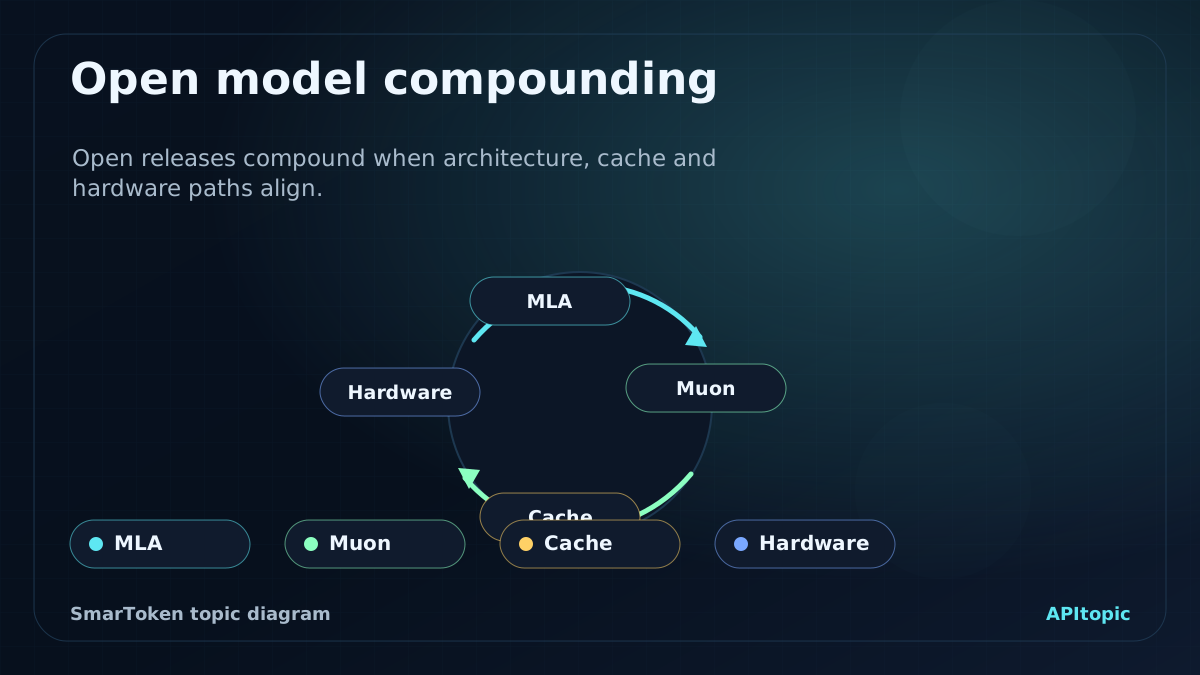
SmarToken editorial diagram for Open model compounding: MLA, Muon, Cache, Hardware.
Compounding loop for reading DeepSeek and Kimi open releases through architecture and deployment reuse.
  • Read DeepSeek and Kimi as competitors inside a shared open technical field.
  • Track which ideas are cited, reused or validated at scale.
  • Retest claims on actual workflows before drawing procurement conclusions.
ThreadObservationReading
MLAKimi uses DeepSeek-style latent attention ideas.Attention compression is becoming a shared long-context tool.
MuonDeepSeek V4 cites optimizer work validated by Kimi at scale.Training stability ideas spread through open reports.
KV cacheBoth teams attack long-context serving cost.Serving architecture is now part of model capability.
HardwareBoth explore paths beyond pure NVIDIA serving.Deployment diversity is becoming strategic.

DeepSeek and Kimi meet at the same bottlenecks

repeated moments when the two teams released related work around reasoning, attention, theorem proving, residual design and trillion-scale MoE models.

The exact release timing is less important than the pattern. Frontier model progress is constrained by similar problems. Once teams push long reasoning, long context and code agents, they all run into attention cost, cache growth, optimizer stability and serving complexity. DeepSeek and Kimi are interesting because they expose more of that work than closed vendors do.

  • Compare technical reports, not only product pages.
  • Look for repeated bottlenecks across releases.
  • Use shared bottlenecks to design evaluation prompts.

Open influence shows up outside China too

This page points to international benchmarks, product bases and usage rankings where DeepSeek and Kimi appear as external comparison or underlying model choices.

This is the market signal behind the technical story. If developers, platforms and product teams use open Chinese models as bases or baselines, their influence grows beyond brand visibility. Phrase these examples carefully: some are official benchmark references, while others are community-reported model-base findings that need verification before being treated as hard facts.

  • Separate official benchmark use from community reverse engineering.
  • Watch OpenRouter-style usage as a demand signal, not final proof.
  • Track how often open models become hidden infrastructure.

KV cache and long context are the shared engineering frontier

both teams are trying to make long context cheaper and more stable by changing attention and cache behavior.

That is the practical frontier for readers. Long context is not just accepting a million tokens. It is reading them at tolerable cost, keeping latency reasonable, preventing cache memory from exploding and still producing grounded answers. The DeepSeek and Kimi examples should push readers to test context quality and serving cost together.

  • Measure long-context grounding and cost together.
  • Check KV-cache behavior under repeated agent calls.
  • Compare direct long-context calls with retrieval-based designs.

Competition is the surface; ecosystem acceleration is the result

This page concludes that DeepSeek and Kimi compete, but their open releases also accelerate the broader ecosystem through citations, reuse and hardware validation.

That is the conclusion too. Closed model races can produce strong products, but open reports and weights produce shared learning. For developers, the win is optionality: more inspectable models, more serving routes, more pricing pressure and more chances to adapt models to local hardware or workflow needs.

  • Evaluate open models as infrastructure candidates.
  • Use openness to reproduce, adapt and audit.
  • Expect fast changes as teams keep learning from each other.

Common mistakes to avoid

Mistake

Treating one article as a final ranking

Why it hurts

Model releases, pricing, quotas and benchmark positions can change quickly.

Better move

Use the analysis as a shortlist, then run current checks against your own workload.

Mistake

Choosing by brand instead of task

Why it hurts

A strong chat model may still be weak for long documents, coding agents, multimodal work or low-latency routes.

Better move

Define the job first, then compare models with prompts, files or media that match that job.

Mistake

Copying claims without a current verification check

Why it hurts

Benchmark numbers, context windows, API names and prices may be dated or provider-specific.

Better move

Confirm high-impact details against official docs, model cards or live provider pages.

Read it as a model briefing, not a setup guide

View model catalog ->

Use this page to understand the model family, the evaluation angle and the current conversation around it. Then choose one or two realistic prompts, documents or media tasks and test whether the model behaves well in your own workflow.

FAQ

These questions reflect recurring reader concerns around Chinese model knowledge, evaluation and fast-moving model releases.

What is the main point of DeepSeek and Kimi: how China's open models are compounding?

The central point is that DeepSeek and Kimi are no longer isolated success stories. Their open model releases, architecture choices and citations are starting to compound: Kimi uses DeepSeek-style MLA, DeepSeek V4 uses Muon ideas validated at scale by Kimi, and both are pushing long context, KV-cache engineering and domestic hardware paths. This page reads the piece as an open-source ecosystem story, not only a rivalry.

How should readers use the Chinese model context here?

Use it as market and product context, then verify technical claims, pricing, quotas and release details against official pages or your own tests before making a decision.

Why is there a short video with the page?

The video gives a fast visual summary of the model story, while the written page carries the caveats, comparisons and practical checks.

References and verification

SmarToken tracks public model releases, technical reports, product announcements and market signals to keep this catalog useful.

Technical claims need to be treated as dated unless they are confirmed by current official model cards, technical reports or provider announcements.

Pricing, quota, availability and benchmark details can change after the review date, so production decisions should use current vendor pages and direct workload tests.

Get API Key