
APItopic
Model explainer7 min read/Updated 2026-05-25

Doubao Seed 2.0: multimodal understanding, agent work and coding

This page frames Doubao Seed 2.0 as ByteDance's major 2.0 model step after strong visual releases such as Seedance 2.0 and Seedream 5.0 Lite. The main claims are stronger multimodal understanding, enterprise-grade agent skills, coding, math and more efficient reasoning. This page reads the release as a workflow upgrade story: from consumer visual fun to production-shaped coding, data and agent tasks.
Key takeaways

  1. 01Doubao Seed 2.0 as ByteDance's largest model update in 21 months, following high-profile Seedance and Seedream releases.
  2. 02The core practical angle is workflow breadth: multimodal understanding, coding, math, visual reasoning and enterprise agents.
  3. 03Benchmark and demo claims need to be treated as reported until checked on real code, documents and agent workflows.
Doubao Seed 2.0: multimodal understanding, agent work and coding video guide. A short SmarToken video for Doubao Seed 2.0: Multimodal Understanding, Agent Work And Coding, focused on model knowledge, evaluation angles and practical takeaways.

Seed 2.0 is framed as Doubao's full-stack model step

Doubao Seed 2.0 improves multimodal understanding, agent behavior, coding, math and token efficiency after the popularity of Seedance 2.0 and Seedream 5.0 Lite.

That makes the release broader than a visual-model update. Seedance and Seedream showed consumer-facing visual momentum. Seed 2.0 is the central model layer that should support code, reasoning, tools and enterprise workflows. The release is presented as a move from spectacle to work.

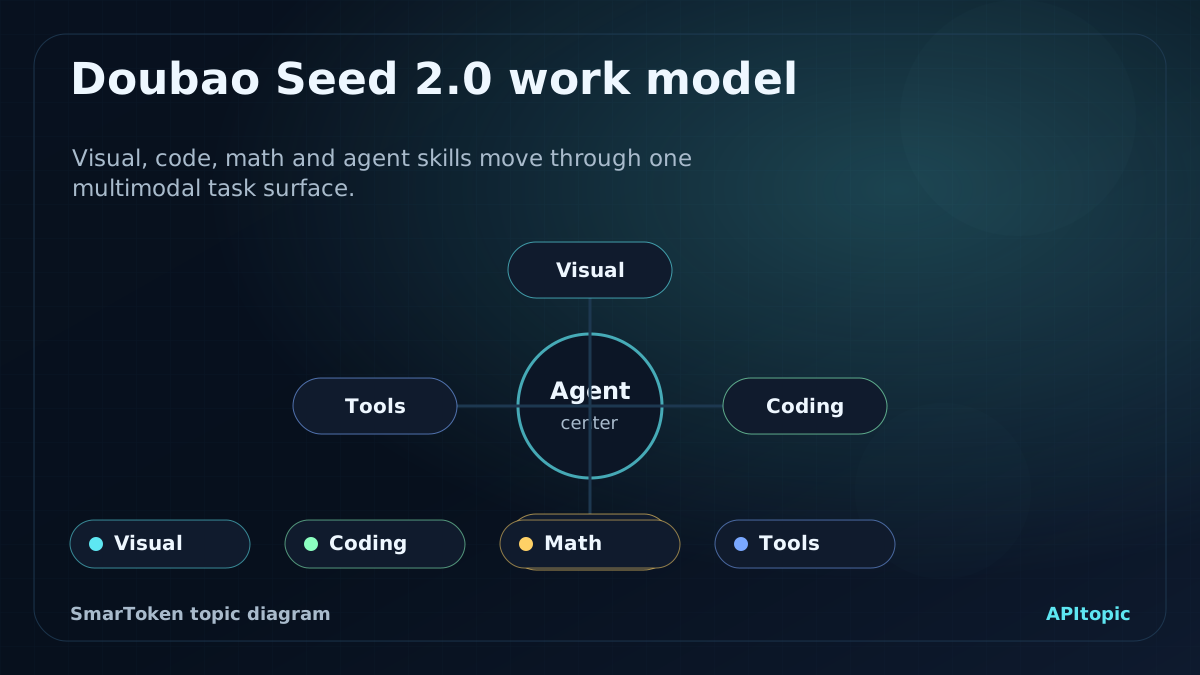
SmarToken editorial diagram for Doubao Seed 2.0 work model: Visual, Coding, Math, Tools.
Multimodal work diagram for evaluating Doubao Seed 2.0 across visual, coding, math and tool-use tasks.
  • Separate visual demos from model workflow claims.
  • Test code, math and agent tasks directly.
  • Track whether stronger capability also improves cost per task.
LaneCore themeValidation step
MultimodalCharts, text extraction, video and spatial reasoning.Use known-answer visual tasks.
CodingTRAE demos generate games and systems.Run and inspect generated apps.
AgentsSkills, tool calls and structured output improve.Test long multi-step workflows.
EfficiencyReasoning tokens become more efficient.Measure cost per successful output.

The coding demos should be run, not just watched

Doubao through front-end and 3D-style coding demos, including a cube solver, physics simulation, board game and Minecraft-like scene.

These demos are good for showing model ambition, but generated software needs engineering review. A polished video does not prove maintainability, responsiveness, accessibility or correctness. The right advice is simple: run the generated project, inspect files, test interactions and compare the result against the prompt.

  • Run generated code locally.
  • Inspect layout and interaction behavior.
  • Look for brittle dependencies or hidden errors.

Visual reasoning is more than image description

Seed 2.0 improves chart, text, spatial, motion and visual-logic understanding.

That is important because enterprise multimodal tasks often involve receipts, charts, screenshots, diagrams and videos. Caption quality is not enough. A useful model must extract the right text, reason over relationships and explain uncertainty. For practical use, run known-answer visual tests before adoption.

  • Use diagrams with hidden traps.
  • Ask for extracted values and reasoning steps.
  • Compare answers with manual ground truth.

Enterprise agents need stable tools and formats

Seed 2.0 better understands skills, function calls, search and tool use, with more stable structured output and context management.

This is where a strong base model becomes a product platform. Enterprise agents must follow instructions, call the right tool, keep context under control and return formats that downstream systems can parse. For practical use, test failed-tool paths and format stability, not only happy-path demos.

  • Test JSON and tool-call stability.
  • Include failed search or failed tool cases.
  • Measure long-task completion, not only first response quality.

Seed 2.0 should be judged by repeatability

The conclusion is that Doubao became steadier and more work-oriented. The practical conclusion is that repeatable delivery will decide whether that is true.

A model can generate impressive one-off demos and still fail daily workflows. The practical evaluation should include a small benchmark pack: one coding task, one chart task, one math task, one tool-call task and one long enterprise-agent workflow. If Seed 2.0 completes those reliably at the expected cost, the upgrade matters.

  • Build a workflow-shaped evaluation pack.
  • Record failures and repair loops.
  • Compare Doubao with adjacent Chinese model families.

Common mistakes to avoid

Mistake

Treating one article as a final ranking

Why it hurts

Model releases, pricing, quotas and benchmark positions can change quickly.

Better move

Use the analysis as a shortlist, then run current checks against your own workload.

Mistake

Choosing by brand instead of task

Why it hurts

A strong chat model may still be weak for long documents, coding agents, multimodal work or low-latency routes.

Better move

Define the job first, then compare models with prompts, files or media that match that job.

Mistake

Copying claims without a current verification check

Why it hurts

Benchmark numbers, context windows, API names and prices may be dated or provider-specific.

Better move

Confirm high-impact details against official docs, model cards or live provider pages.

Read it as a model briefing, not a setup guide

View model catalog ->

Use this page to understand the model family, the evaluation angle and the current conversation around it. Then choose one or two realistic prompts, documents or media tasks and test whether the model behaves well in your own workflow.

FAQ

These questions reflect recurring reader concerns around Chinese model knowledge, evaluation and fast-moving model releases.

What is the main point of Doubao Seed 2.0: multimodal understanding, agent work and coding?

This page frames Doubao Seed 2.0 as ByteDance's major 2.0 model step after strong visual releases such as Seedance 2.0 and Seedream 5.0 Lite. The main claims are stronger multimodal understanding, enterprise-grade agent skills, coding, math and more efficient reasoning. This page reads the release as a workflow upgrade story: from consumer visual fun to production-shaped coding, data and agent tasks.

How should readers use the Chinese model context here?

Use it as market and product context, then verify technical claims, pricing, quotas and release details against official pages or your own tests before making a decision.

Why is there a short video with the page?

The video gives a fast visual summary of the model story, while the written page carries the caveats, comparisons and practical checks.

References and verification

SmarToken tracks public model releases, technical reports, product announcements and market signals to keep this catalog useful.

Technical claims need to be treated as dated unless they are confirmed by current official model cards, technical reports or provider announcements.

Pricing, quota, availability and benchmark details can change after the review date, so production decisions should use current vendor pages and direct workload tests.

Get API Key