
APItopic
Model explainer7 min read/Updated 2026-05-25

Doubao token usage: 120 trillion daily tokens and the AI cloud war

120 trillion daily tokens is treated as a signal that AI has moved from chat demos to real cloud consumption. It says the surge comes mainly from AI video generation and agent workflows, where tool calls, multimodal inputs and long-running tasks burn far more tokens than simple chat. This page reads the release as a token-economy analysis: token volume is becoming a cloud usage metric, not only a model-side billing unit.
Key takeaways

  1. 01The analysis uses Doubao's reported 120 trillion daily token usage as a sign that AI cloud demand is moving from chat to work.
  2. 02It names two growth drivers: AI video and agent workflows, both of which consume far more tokens than simple text chat.
  3. 03the page is best read as token-economy analysis: token throughput is becoming a usage metric for AI cloud platforms.
Doubao token usage: 120 trillion daily tokens and the AI cloud war video guide. A short SmarToken video for Doubao Token Usage: 120 Trillion Daily Tokens And The AI Cloud War, focused on model knowledge, evaluation angles and practical takeaways.

120 trillion daily tokens is a cloud-usage story

the reported 120-trillion-token daily figure is treated as evidence that AI is becoming real cloud traffic. The number matters because it reflects model calls across video, agents and enterprise workflows.

A token is not revenue, profit or user satisfaction. But at cloud scale, token volume is a useful signal. It shows whether models are being used after demos end. Doubao's token consumption grew sharply and places Volcano Engine beside OpenAI and Google in daily token volume. This page keeps that claim release-focused and focuses on the broader lesson: token throughput is becoming a visible AI infrastructure metric.

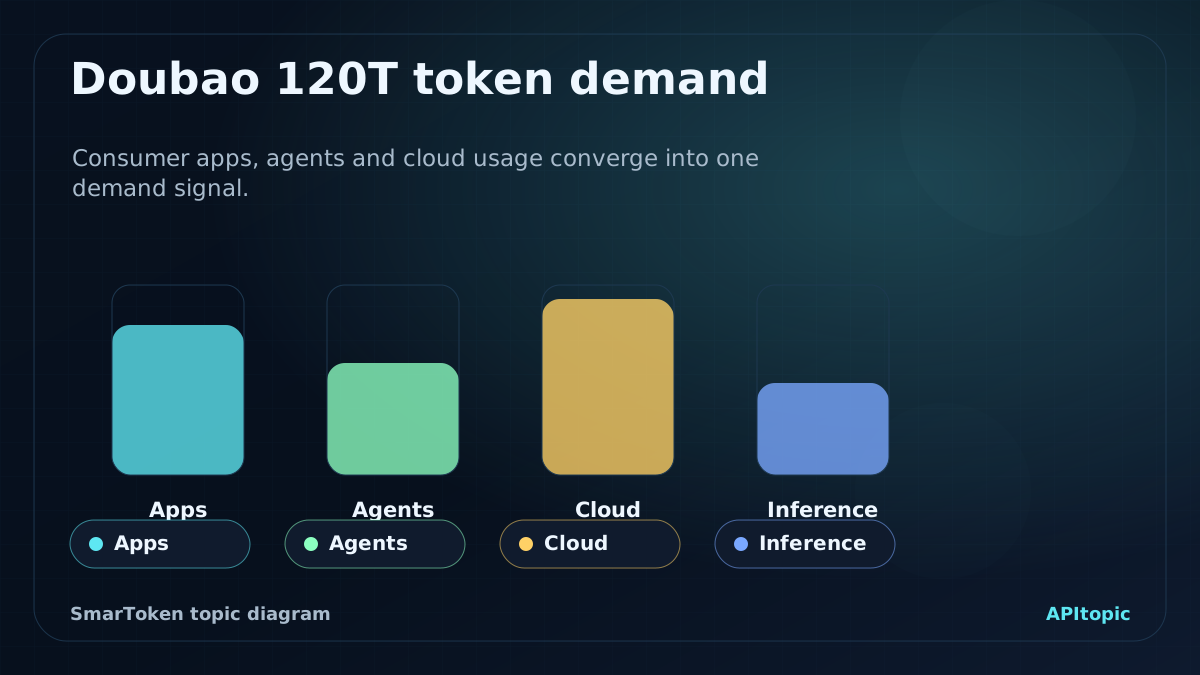
SmarToken editorial diagram for Doubao 120T token demand: Apps, Agents, Cloud, Inference.
Demand diagram explaining why token volume, inference cost and product adoption need to be read together.
  • Token volume signals usage, not business quality by itself.
  • The mix of use cases matters more than the headline number.
  • AI cloud platforms will compete on throughput, price, safety and ecosystem.
Growth driverWhy tokens riseWhat to watch
AI videoVisual and temporal generation is far heavier than text chat.Latency, safety and enterprise rights controls.
AgentsTool calls and multi-step loops multiply context and output.Permissions, skill sources and audit logs.
Enterprise MaaSMore apps call hosted models through APIs.Pricing, uptime, model freshness and data controls.

Video changes the token math

AI video can consume orders of magnitude more tokens than normal chat, especially when users generate high-resolution or reference-driven clips.

That is why video models can bend a usage curve. A short chat answer may consume a small context and one text output. A video model has to represent motion, timing, frames, references and safety checks. This page connects this demand to Seedance 2.0 and creator usage. Keep the conclusion practical: video demand can make AI cloud usage grow even when user counts do not grow at the same speed.

  • Video workloads are token-heavy and compute-heavy.
  • Reference files and multimodal inputs increase demand.
  • Enterprise video adoption depends on rights and safety controls.

Agents multiply tokens through tool loops

Agents consume more tokens because they plan, call tools, inspect outputs, retry and summarize. One agent workflow can be much larger than one chat turn.

The analysis uses OpenClaw, skills and China's ClawHub mirror to explain why token demand spreads beyond chat. A skill ecosystem gives agents more things to do. More things to do means more tool calls, more context and more verification. This is where token usage becomes a proxy for work performed, though not always for work completed well.

  • Every skill call can add context, output and verification tokens.
  • More agent autonomy requires stronger permission control.
  • Usage growth should be paired with completion and safety metrics.

Enterprise adoption is blocked by models, skills and safety

The central point is that enterprises struggle to adopt agents because they need the right model, a reliable skill ecosystem and strong safety controls.

This is a useful operational frame. A powerful model without tools cannot complete real work. A wide skill ecosystem without governance can create security risk. Safety controls without usable workflows can slow adoption. The three-part requirement is clear: model capability, skill availability and permissioned execution.

  • Model capability is the brain.
  • Skills are the hands and tools.
  • Security is the adoption gate.

Token volume may become an AI-era operating metric

This page compares token usage to electricity or data traffic: a measure of how much AI work is flowing through cloud infrastructure.

That comparison is directionally useful. In the electricity era, consumption signaled industrial activity. In the internet era, traffic signaled digital activity. In the AI era, token throughput may signal model-mediated work. But it still needs context. A company can burn many tokens inefficiently. The better metric will combine token volume with task success, cost, latency, safety and user retention.

  • Track tokens alongside successful task completion.
  • Watch cost per useful output.
  • Separate training spend from inference and MaaS revenue.

Common mistakes to avoid

Mistake

Treating one article as a final ranking

Why it hurts

Model releases, pricing, quotas and benchmark positions can change quickly.

Better move

Use the analysis as a shortlist, then run current checks against your own workload.

Mistake

Choosing by brand instead of task

Why it hurts

A strong chat model may still be weak for long documents, coding agents, multimodal work or low-latency routes.

Better move

Define the job first, then compare models with prompts, files or media that match that job.

Mistake

Copying claims without a current verification check

Why it hurts

Benchmark numbers, context windows, API names and prices may be dated or provider-specific.

Better move

Confirm high-impact details against official docs, model cards or live provider pages.

Read it as a model briefing, not a setup guide

View model catalog ->

Use this page to understand the model family, the evaluation angle and the current conversation around it. Then choose one or two realistic prompts, documents or media tasks and test whether the model behaves well in your own workflow.

FAQ

These questions reflect recurring reader concerns around Chinese model knowledge, evaluation and fast-moving model releases.

What is the main point of Doubao token usage: 120 trillion daily tokens and the AI cloud war?

120 trillion daily tokens is treated as a signal that AI has moved from chat demos to real cloud consumption. It says the surge comes mainly from AI video generation and agent workflows, where tool calls, multimodal inputs and long-running tasks burn far more tokens than simple chat. This page reads the release as a token-economy analysis: token volume is becoming a cloud usage metric, not only a model-side billing unit.

How should readers use the Chinese model context here?

Use it as market and product context, then verify technical claims, pricing, quotas and release details against official pages or your own tests before making a decision.

Why is there a short video with the page?

The video gives a fast visual summary of the model story, while the written page carries the caveats, comparisons and practical checks.

References and verification

SmarToken tracks public model releases, technical reports, product announcements and market signals to keep this catalog useful.

Technical claims need to be treated as dated unless they are confirmed by current official model cards, technical reports or provider announcements.

Pricing, quota, availability and benchmark details can change after the review date, so production decisions should use current vendor pages and direct workload tests.

Get API Key