Zhipu Qingyan GLM-4 review: free AI assistant and agent workflow
The reviews Zhipu Qingyan as a free AI assistant built on GLM-4. Its useful structure is practical: text writing, logic, math, coding, fresh search, long-document reading, image generation and custom agents. the review is treated as a workflow guide rather than a universal 'best tool' claim: Qingyan is most interesting where Chinese-language work, document analysis and low-barrier agent creation meet.
Key takeaways
01The reviews Zhipu Qingyan through everyday product surfaces rather than only benchmark names.
02The most useful The practical angle is workflow fit: writing, logic, coding, documents, images and user-created agents.
03This page is enthusiastic, so The page preserves the hands-on cases while adding caution around verification, permissions and changing product features.
Zhipu Qingyan GLM-4 review: free AI assistant and agent workflow video guide. A short SmarToken video for Zhipu Qingyan GLM-4 Review: Free AI Assistant And Agent Workflow, focused on model knowledge, evaluation angles and practical takeaways.
This page tests Qingyan as a product, not only a model
The review uses Zhipu Qingyan to test common work tasks: writing, outlines, logic, math, code, fresh search, document reading, image generation and custom agents.
That makes the review more useful than a benchmark recap. Benchmarks can show model potential, but product users care about workflow surfaces. Can the tool write a usable report outline? Can it explain a logical trap? Can it read a paper or compare resumes? Can a non-expert create an agent? This page keeps that product-first structure.
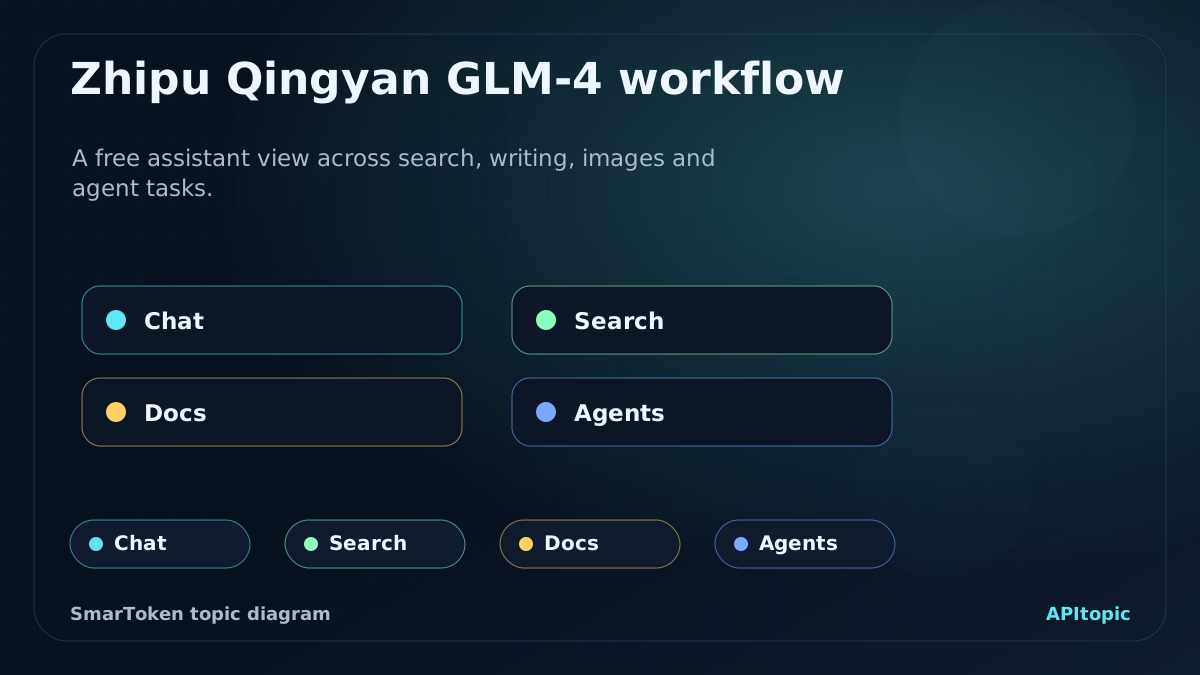
Workflow diagram for matching Zhipu Qingyan GLM-4 features to everyday assistant use cases.
The review is about Qingyan's user experience on top of GLM-4.
The strongest sections are document reading and custom agents.
Feature availability need a refresh because this page is dated.
Workflow
Observation
Reader check
Writing
Useful for summaries, reports and content outlines.
Edit for voice and remove generic phrasing.
Search
Can return citation-backed current answers.
Check evidence quality and date.
Documents
Supports long-document reading and comparison.
Verify citations and omissions.
Agents
Users can configure role-specific assistants.
Review tools, permissions and knowledge sources.
Writing quality is strongest when the task is practical
Qingyan is useful for workplace templates, outlines and AI-product reviews, especially when the user needs a clean first draft.
This is a realistic use case. Many office writing tasks are not literary; they need structure, brevity and low friction. Qingyan's value in this page is not that it replaces an editor. It reduces the blank-page problem and gives users a draft to revise. For practical use, add human editing before production or external use.
Use it for first drafts, outlines and internal writing.
Rewrite visible content for tone and specificity.
Avoid publishing generated claims without evidence checks.
Logic, math and code tests show model breadth
The analysis uses logic traps, math reasoning and coding examples to show that GLM-4 is a broad assistant, not only a copywriter.
These examples matter because a productivity assistant often moves between tasks. A user may ask for a report outline, then a formula, then a script. The review suggests Qingyan can handle that range. Still, Keep the standard verification rule: reasoning should expose assumptions, math should be recalculated and code should run in a sandbox.
Ask the model to state assumptions in reasoning tasks.
Recalculate math answers manually or with tools.
Run code before trusting it.
Document reading is the most work-shaped feature
The strongest practical examples are long-document reading, paper summarization and document comparison, including resume screening.
This is where Qingyan becomes more than a chatbot. Document workflows require ingestion, extraction, comparison and question answering. A tool that handles several documents can save time, but only if it cites the right details and does not flatten important differences. For practical use, use Qingyan as a triage layer, not the final decision maker.
Use document reading for first-pass summaries.
Ask for direct quotes or page references where possible.
Keep humans responsible for hiring, legal and academic judgments.
Custom agents lower the automation barrier
Qingyan's agent builder lets users create role-specific assistants with prompts, uploaded knowledge and external tools.
That is the product's most forward-looking part. A custom agent can turn a repeated task into a reusable workflow. But it also introduces risk. The more tools and external data an agent can use, the more important permissioning, logging and review become. Frame custom agents as controlled automation, not unsupervised delegation.
Start with narrow tasks and known data.
Limit tool access until the agent proves reliable.
Review outputs before any external action.
Common mistakes to avoid
Mistake
Treating one article as a final ranking
Why it hurts
Model releases, pricing, quotas and benchmark positions can change quickly.
Better move
Use the analysis as a shortlist, then run current checks against your own workload.
Mistake
Choosing by brand instead of task
Why it hurts
A strong chat model may still be weak for long documents, coding agents, multimodal work or low-latency routes.
Better move
Define the job first, then compare models with prompts, files or media that match that job.
Mistake
Copying claims without a current verification check
Why it hurts
Benchmark numbers, context windows, API names and prices may be dated or provider-specific.
Better move
Confirm high-impact details against official docs, model cards or live provider pages.
Turn the article into a short test plan: pick realistic prompts, compare outputs against one or two alternative model families and record quality, latency and cost before choosing a route.
FAQ
These questions reflect recurring reader concerns around Chinese model knowledge, evaluation and fast-moving model releases.
What is the main point of Zhipu Qingyan GLM-4 review: free AI assistant and agent workflow?
The reviews Zhipu Qingyan as a free AI assistant built on GLM-4. Its useful structure is practical: text writing, logic, math, coding, fresh search, long-document reading, image generation and custom agents. the review is treated as a workflow guide rather than a universal 'best tool' claim: Qingyan is most interesting where Chinese-language work, document analysis and low-barrier agent creation meet.
How should readers use the Chinese model context here?
Use it as market and product context, then verify technical claims, pricing, quotas and release details against official pages or your own tests before making a decision.
Why is there a short video with the page?
The video gives a fast visual summary of the model story, while the written page carries the caveats, comparisons and practical checks.
References and verification
SmarToken tracks public model releases, technical reports, product announcements and market signals to keep this catalog useful.
Technical claims need to be treated as dated unless they are confirmed by current official model cards, technical reports or provider announcements.
Pricing, quota, availability and benchmark details can change after the review date, so production decisions should use current vendor pages and direct workload tests.