
APItopic
Model explainer7 min read/Updated 2026-05-25

StepFun Step 3.5 Flash: speed, funding and AI-terminal strategy

The central point is that StepFun has entered China's first-tier AI model race through three signals: Step 3.5 Flash is fast enough for agent workloads, the company has major new financing and leadership depth, and its commercial strategy focuses on native multimodal AI for terminals such as phones and cars. This page reads the release as a strategy brief, not only a model benchmark report.
Key takeaways

  1. 01This page argues StepFun is entering China's first-tier model race through model speed, financing and a terminal-focused strategy.
  2. 02Step 3.5 Flash is framed as an agent base model where fast inference matters because users care about task completion time.
  3. 03Treat rankings, financing and deployment numbers as reported while focusing on the strategic pattern.
StepFun Step 3.5 Flash: speed, funding and AI-terminal strategy video guide. A short SmarToken video for StepFun Step 3.5 Flash: Speed, Funding And AI-Terminal Strategy, focused on model knowledge, evaluation angles and practical takeaways.

The page is a strategy brief, not only a model review

StepFun has broken into the first-tier race because it now has a fast agent model, major financing, a stronger leadership bench and a differentiated AI-terminal route.

That is broader than a benchmark story. The page describes a market entering a playoff phase, where only teams with training capital, commercialization paths and user access can continue. StepFun's case is built from several signals: Step 3.5 Flash, reported financing, leadership changes and terminal partnerships. This page keeps that combined strategic frame.

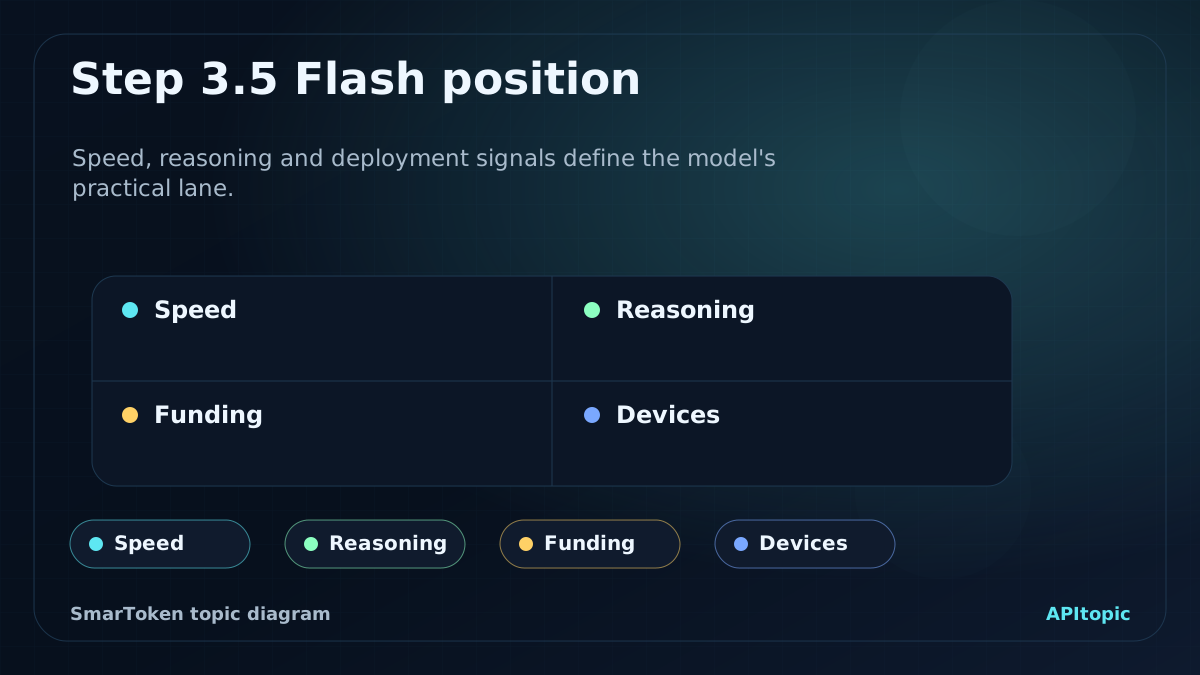
SmarToken editorial diagram for Step 3.5 Flash position: Speed, Reasoning, Funding, Devices.
Positioning matrix for Step 3.5 Flash across speed, reasoning quality and deployment readiness.
  • Speed matters for agent task completion.
  • Capital matters for continued frontier training.
  • Terminal distribution matters for real user access.
SignalReported claimReader question
ModelStep 3.5 Flash is fast and strong at math reasoning.Does it finish real agent tasks faster?
CapitalStepFun reportedly raised a large B+ round.Can funding support next-generation base models?
StrategyThe company focuses on AI+terminal and native multimodality.Can terminal deployments become durable revenue?

Fast inference changes agent UX

The central point is that in agent workflows, users do not watch every token. They wait for the task to finish. That makes speed a user-experience feature.

This is a strong point. Chatbots can feel acceptable while streaming slowly if the answer is visible. Agents are different. They run searches, call tools, inspect outputs and generate final artifacts. If every step is slow, the whole task feels broken. Step 3.5 Flash is positioned as a base model for that environment.

  • Measure total task completion time, not only tokens per second.
  • Test multi-step tool workflows.
  • Compare latency and quality together.

Math performance is used as an intelligence signal

The analysis uses math benchmark results to argue that Step 3.5 Flash is not only fast, but also strong at difficult reasoning.

Math benchmarks are useful because they reveal structured reasoning under constraints. But they are not the same as enterprise or terminal workflows. Treat them as one signal. The next tests should combine reasoning with tool use, multimodal inputs and terminal actions.

  • Use math as a reasoning screen.
  • Add agent and multimodal tests for product fit.
  • Keep benchmark claims dated.

AI+terminal is StepFun's differentiated route

StepFun is betting on AI terminals and native multimodality: phones, cars, voice, GUI agents and endpoint assistants.

This is where the company story becomes distinct. Many AI companies sell subscriptions or APIs. StepFun's release story emphasizes models that see, hear and operate across terminals. If that route works, the model is not only an API; it becomes a sensory and action layer for consumer devices.

  • Test voice, GUI and visual perception together.
  • Watch endpoint latency and model size.
  • Check whether terminal partners create recurring usage.

First-tier status depends on repeatable delivery

This page argues StepFun has entered the first tier, but the durable test is whether it can keep releasing stronger base models and convert terminal deployments into usage.

That is the conclusion. Financing, speed and rankings make StepFun worth watching. Sustained first-tier status requires something harder: repeated model releases, distribution, enterprise or consumer use, and a clear path from model capability to revenue. The page is a strong signal, not a final verdict.

  • Track future base-model releases.
  • Track API call growth and terminal deployment.
  • Compare actual workflow quality with adjacent Chinese model families.

Common mistakes to avoid

Mistake

Treating one article as a final ranking

Why it hurts

Model releases, pricing, quotas and benchmark positions can change quickly.

Better move

Use the analysis as a shortlist, then run current checks against your own workload.

Mistake

Choosing by brand instead of task

Why it hurts

A strong chat model may still be weak for long documents, coding agents, multimodal work or low-latency routes.

Better move

Define the job first, then compare models with prompts, files or media that match that job.

Mistake

Copying claims without a current verification check

Why it hurts

Benchmark numbers, context windows, API names and prices may be dated or provider-specific.

Better move

Confirm high-impact details against official docs, model cards or live provider pages.

Read it as a model briefing, not a setup guide

View model catalog ->

Use this page to understand the model family, the evaluation angle and the current conversation around it. Then choose one or two realistic prompts, documents or media tasks and test whether the model behaves well in your own workflow.

FAQ

These questions reflect recurring reader concerns around Chinese model knowledge, evaluation and fast-moving model releases.

What is the main point of StepFun Step 3.5 Flash: speed, funding and AI-terminal strategy?

The central point is that StepFun has entered China's first-tier AI model race through three signals: Step 3.5 Flash is fast enough for agent workloads, the company has major new financing and leadership depth, and its commercial strategy focuses on native multimodal AI for terminals such as phones and cars. This page reads the release as a strategy brief, not only a model benchmark report.

How should readers use the Chinese model context here?

Use it as market and product context, then verify technical claims, pricing, quotas and release details against official pages or your own tests before making a decision.

Why is there a short video with the page?

The video gives a fast visual summary of the model story, while the written page carries the caveats, comparisons and practical checks.

References and verification

SmarToken tracks public model releases, technical reports, product announcements and market signals to keep this catalog useful.

Technical claims need to be treated as dated unless they are confirmed by current official model cards, technical reports or provider announcements.

Pricing, quota, availability and benchmark details can change after the review date, so production decisions should use current vendor pages and direct workload tests.

Get API Key