
APItopic
Model explainer7 min read/Updated 2026-05-25

Elephant Alpha: a 100B token-efficient work model from Inclusion AI

the mysterious Elephant Alpha model as coming from Ant Group's Inclusion AI team. It describes a 100B model with a 256K context window and 32K output that is optimized for fast, concise work. In hands-on tests, this page emphasizes bug fixing, meeting-summary extraction and lightweight agent loops. This page reads Elephant as a useful reminder that token efficiency can be a product feature, not only a cost metric.
Key takeaways

  1. 01Elephant Alpha as an Inclusion AI model that drew attention on OpenRouter.
  2. 02The durable point is token efficiency: concise output, fast response and less wasted context can matter as much as headline scale.
  3. 03Elephant is presented as a work-model candidate for bounded tasks, while preserving the cautions about vague prompts, fresh APIs and complex strategy work.
Elephant Alpha: a 100B token-efficient work model from Inclusion AI video guide. A short SmarToken video for Elephant Alpha: A 100B Token-Efficient Work Model From Inclusion AI, focused on model knowledge, evaluation angles and practical takeaways.

Elephant's signal is efficiency, not only size

Elephant Alpha is a 100B model from Inclusion AI with a 256K context window and 32K output, designed to be fast, concise and token efficient.

That positioning is different from the usual frontier-model story. A 100B model is not small in absolute terms, but the central point is that Elephant feels agile because it avoids unnecessary output and focuses on the job. For developers, that can matter. In multi-step agents, every verbose answer adds cost, context clutter and latency. A concise model is useful if it still preserves accuracy.

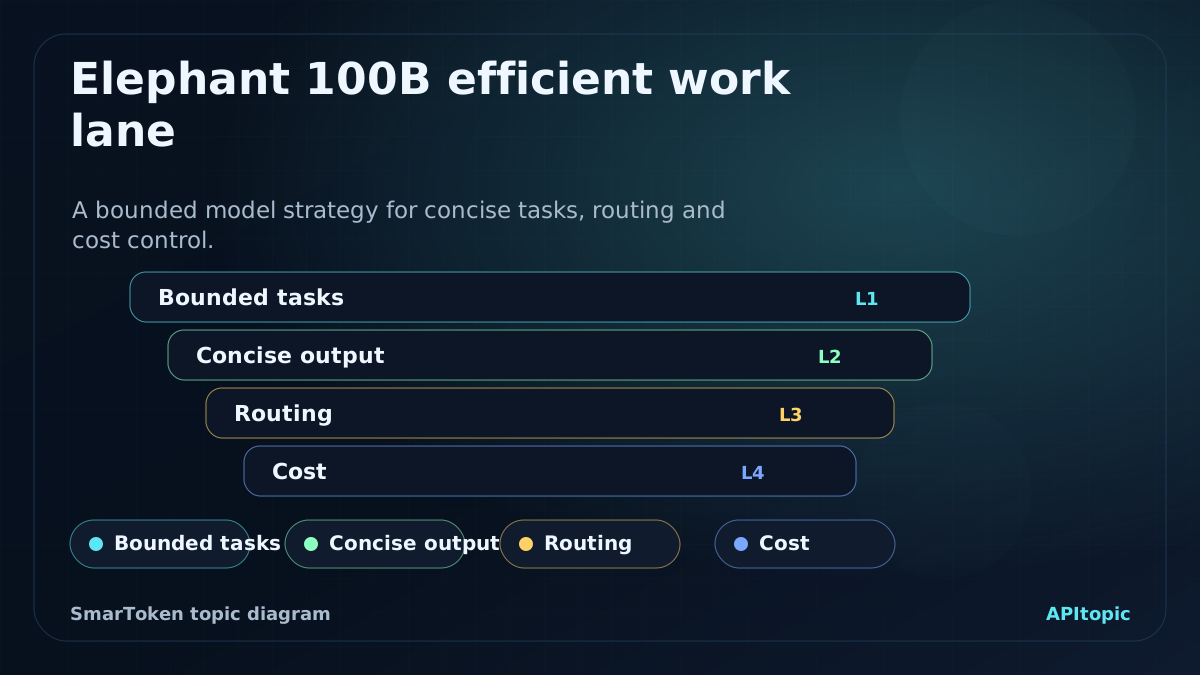
SmarToken editorial diagram for Elephant 100B efficient work lane: Bounded tasks, Concise output, Routing, Cost.
Efficiency diagram for reading Elephant 100B as a practical work model rather than a benchmark-only release.
  • Evaluate cost per completed task, not only model size.
  • Measure output length and repair loops together.
  • Use strict prompts to test whether concise output stays complete.
TestObservationReader check
Bug repairFinds the missing variable without rewriting everything.Run the fixed file and diff the patch.
Meeting notesExtracts action items and a follow-up email in JSON format.Validate format and missing owners.
Sales CSV loopAnalyzes, self-checks and finalizes quickly.Recalculate the numbers.
Vague web taskQuality drops when the prompt is underspecified.Add layout and output constraints.

The bug-fix test rewards minimal change

The coding test matters because Elephant fixes a specific missing-variable error instead of regenerating a large block of code.

That is exactly what many developers want from an assistant. When a model rewrites too much, it creates new review work and burns tokens. A model that finds the narrow bug and explains the fix can be more useful in day-to-day coding than a model that produces longer, more dramatic output. Frame this as maintainability, not only speed.

  • Ask for a minimal patch first.
  • Compare diff size and correctness.
  • Run the code after repair.

Document extraction shows the value of clean constraints

Elephant a noisy meeting note and asks for a strict JSON output with summary, action items, owners and a follow-up email.

This is a practical office task. It rewards a model that can ignore small talk, preserve useful decisions and obey a format. It also shows how to prompt token-efficient models well: give a clear schema, name what to ignore and define the output shape. Without those constraints, even a fast model may produce shallow or generic content.

  • Use schemas for extraction tasks.
  • Tell the model which noise to ignore.
  • Check responsible owners and dates manually.

Lightweight agent loops are a natural fit

The CSV test asks Elephant to read monthly sales data, calculate quarterly year-over-year change, write a short conclusion and self-check the numbers.

That pattern suits a fast work model. The task is bounded, the data is present and the required self-check is clear. Elephant's reported performance suggests a route for practical use: let smaller efficient models handle frequent, narrow loops while reserving larger models for open-ended reasoning or strategy.

  • Keep the data inside the prompt or file context.
  • Ask for a calculation trace and final answer.
  • Route high-stakes strategy elsewhere unless tools are attached.

The limits are useful buying guidance

Elephant is weaker on vague prompts, very new knowledge and broad strategy projects that require external tools.

Those limits make the review more credible. A model optimized for fast, concise work may not be the right planner for a six-month market-entry strategy. It may also hallucinate new SDK details unless current documentation is provided. For practical use, a hybrid route: use a larger planner or tool-connected agent for broad projects, then send narrow execution tasks to Elephant-style models.

  • Inject current docs for new APIs.
  • Avoid vague prompts such as build a nice page.
  • Pair planning models with efficient execution models.

Common mistakes to avoid

Mistake

Treating one article as a final ranking

Why it hurts

Model releases, pricing, quotas and benchmark positions can change quickly.

Better move

Use the analysis as a shortlist, then run current checks against your own workload.

Mistake

Choosing by brand instead of task

Why it hurts

A strong chat model may still be weak for long documents, coding agents, multimodal work or low-latency routes.

Better move

Define the job first, then compare models with prompts, files or media that match that job.

Mistake

Copying claims without a current verification check

Why it hurts

Benchmark numbers, context windows, API names and prices may be dated or provider-specific.

Better move

Confirm high-impact details against official docs, model cards or live provider pages.

Read it as a model briefing, not a setup guide

View model catalog ->

Use this page to understand the model family, the evaluation angle and the current conversation around it. Then choose one or two realistic prompts, documents or media tasks and test whether the model behaves well in your own workflow.

FAQ

These questions reflect recurring reader concerns around Chinese model knowledge, evaluation and fast-moving model releases.

What is the main point of Elephant Alpha: a 100B token-efficient work model from Inclusion AI?

the mysterious Elephant Alpha model as coming from Ant Group's Inclusion AI team. It describes a 100B model with a 256K context window and 32K output that is optimized for fast, concise work. In hands-on tests, this page emphasizes bug fixing, meeting-summary extraction and lightweight agent loops. This page reads Elephant as a useful reminder that token efficiency can be a product feature, not only a cost metric.

How should readers use the Chinese model context here?

Use it as market and product context, then verify technical claims, pricing, quotas and release details against official pages or your own tests before making a decision.

Why is there a short video with the page?

The video gives a fast visual summary of the model story, while the written page carries the caveats, comparisons and practical checks.

References and verification

SmarToken tracks public model releases, technical reports, product announcements and market signals to keep this catalog useful.

Technical claims need to be treated as dated unless they are confirmed by current official model cards, technical reports or provider announcements.

Pricing, quota, availability and benchmark details can change after the review date, so production decisions should use current vendor pages and direct workload tests.

Get API Key