
For an overseas developer, the cost of a Chinese AI model depends on the exact provider, model, region and workload—not the family name alone. The table below compares five named direct-provider options using USD per million text tokens. It is a dated starting point, not a quality ranking or a quote for SmarToken. Check the linked official price and account terms before making a commitment.
Prices checked: November 7, 2026. Rates may change. This is a documentation-based comparison; we did not run a paid benchmark or verify account eligibility in every country.
Official API prices at a glance
The figures are standard online, text-token rates. Input is uncached unless stated otherwise. The rows use different providers and model tiers; lower price does not establish that models perform equally on your tasks.
| Model and direct vendor | Input / 1M | Output / 1M | Conditions and source |
|---|---|---|---|
| DeepSeek V4.1 Flash via DeepSeek | $0.15 off-peak; $0.30 peak | $0.60 off-peak; $1.20 peak | Time-based pricing; cached input has separate rates. DeepSeek pricing |
| Qwen3.8-Flash via Alibaba Cloud Model Studio | $0.15 | $0.47 | Singapore, international deployment; up to 1M input tokens per request. Cache discounts and other regions have different terms. Alibaba Cloud pricing |
| Kimi K3.1 Pro via Kimi API | $2.00 | $10.00 | Provider lists cache write and cache hit separately. Kimi platform and billing notes |
| MiniMax M3.1 Flash via MiniMax | $0.15 | $0.60 | Provider lists cache-read pricing separately; review model and service-tier terms. MiniMax pricing |
| Dola Seed 2.1 Turbo via BytePlus ModelArk | $0.50 | $2.50 | Standard online tier, prompt length up to 256K; cache and other service tiers have separate charges. BytePlus pricing |
All figures are USD and exclude applicable taxes, separate tools and other account-specific charges. A zero or missing cache entry in a comparison is not proof that caching is unavailable or free. Pricing may use per-request context tiers, and a vendor can revise models or rates.
DeepSeek defines its direct API peak window as 01:00–04:00 and 06:00–10:00 UTC on weekdays, excluding Chinese public holidays; all other times are off-peak. Convert the window to your own time zone before estimating a mixed schedule. See DeepSeek's current schedule.
How do these rates translate to a real workload?
Suppose an application processes 10 million uncached input tokens and generates 2 million output tokens in a month. Assume each request fits the table's listed prompt tier, no retries and no additional tool, cache, media or tax charges. Multiply the number of millions of input and output tokens by their respective rates.
| Direct-provider example | Calculation | Estimated text-token cost |
|---|---|---|
| DeepSeek Flash, all off-peak | 10 × $0.15 + 2 × $0.60 | $2.70 |
| DeepSeek Flash, all peak | 10 × $0.30 + 2 × $1.20 | $5.40 |
| Qwen3.8-Flash, Singapore international | 10 × $0.15 + 2 × $0.47 | $2.44 |
| Kimi K3.1 Pro | 10 × $2.00 + 2 × $10.00 | $40.00 |
| MiniMax M3.1 Flash | 10 × $0.15 + 2 × $0.60 | $2.70 |
| Dola Seed 2.1 Turbo, listed tier | 10 × $0.50 + 2 × $2.50 | $10.00 |
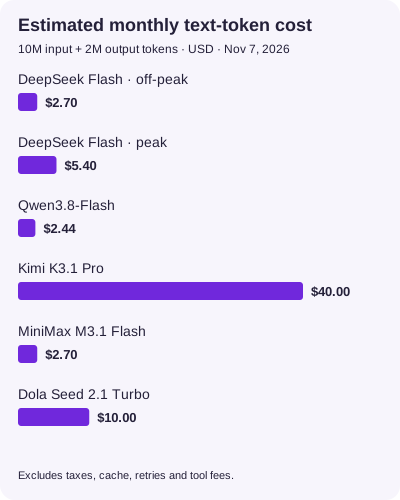
This example normalizes token volume, not model quality. If a cheaper model needs more retries, longer outputs or more human correction, its cost per successful task can be higher. Track failed attempts in total cost and divide by successful tasks; do not calculate that metric when there are no successful tasks.
For example, if 100 attempts cost $5 in total and 80 satisfy your acceptance criteria, the cost per successful task is $0.0625. If another route costs $8 for 100 attempts but 98 pass, its cost per success is about $0.0816. That comparison still excludes human correction unless you measure it. Repeat each test with a representative set and enough runs to understand variation; two model versions can return different results for the same prompt.
The input and output totals are monthly aggregates, but prompt-length tiers apply to each request. A month containing 10 million input tokens does not necessarily mean a single 10-million-token request. Split your estimate by request size and billing tier before applying the appropriate rate. For DeepSeek, also split usage by peak and off-peak windows; the two example rows show extremes, not a prediction of your schedule.
Where do developers access these models?
| Model family | Direct route | Check before integration |
|---|---|---|
| DeepSeek | DeepSeek API | Exact model name, peak schedule, available features and account limits. |
| Qwen | Alibaba Cloud Model Studio | Region, deployment scope, model ID and prompt-length tier. |
| Kimi | Kimi API Platform | Account eligibility, model ID, reasoning settings and current retirement notices. |
| MiniMax | MiniMax API | Model and service tier, cache terms and account limits. |
| ByteDance Seed / Doubao | BytePlus ModelArk or Volcengine Ark | Region, exact model ID and which account and key belong to that provider. |
Our Doubao overseas access guide walks through regions and model IDs. For a model retirement scenario, see the Kimi K2 to K3 migration checklist.
What can I use through SmarToken?
SmarToken's available text routes at the time of review are DeepSeek routes. Other model families in this comparison are included to help readers evaluate the market; they are not a promise of current SmarToken availability. Check the model catalog and SmarToken pricing for its own enabled routes and charges. Vendor direct prices above should not be substituted for gateway prices.
The costs a token-price table can miss
- Input and output mix: Code generation and agents may produce much longer outputs than a classification task. Estimate each separately.
- Cache rules: Cache hits, cache writes and storage may have different rates or minimums. Do not apply a cache discount unless the workload actually qualifies.
- Long-context tiers: Some providers price the whole request at the tier corresponding to its input length. Check the model's current rule.
- Retries and tool use: Include failed attempts, external search or other tools, and the number of calls needed to complete a task.
- Limits and compatibility: A compatible request format does not guarantee identical parameter support, throughput, data handling or availability.
To compare two routes, first run the same permitted test set with clear pass/fail criteria. Record the actual model ID, date, region, prompt sizes, output quality, latency, tokens and retries. Evaluate the complete workflow rather than treating a single vendor benchmark as a universal ranking.
FAQ
Questions about the lowest input price and DeepSeek's peak hours also appear in the China AI Pricing FAQ and an independent DeepSeek pricing guide. The answers below use the direct-provider sources linked above.
Which Chinese AI API is cheapest?
There is no universal cheapest choice. The lowest price depends on the exact model, region, input/output mix, cache behavior and whether the result meets your quality bar. Use the table as a shortlist and calculate your own workload.
Are the prices in this table SmarToken prices?
No. They are selected direct-provider prices. Check SmarToken pricing separately for its current gateway rates and enabled models.
Can I use the same API key with every provider?
No. Direct providers and gateways issue their own keys and use their own base URLs. Follow the documentation for the account you selected and keep keys out of client-side code.
Do DeepSeek peak and off-peak prices apply everywhere?
The rates shown are the direct DeepSeek API's rates and schedule. A gateway or another provider can have different pricing and billing rules.
Sources And Methodology
Prices in this snapshot were checked against the linked first-party pricing pages on November 7, 2026. They are not live prices. If a source or model changes, the affected row must be rechecked before its date is advanced. This page does not claim automatic price updates.
Next step: Create an account or sign in to explore SmarToken's currently available API routes, or review the invite and top-up rewards page. Availability is subject to the campaign's current terms.