
APItopic
Evaluation8 min read/Updated 2026-05-25

2025 AI model annual review: from chat assistants to productivity agents

The central point is that 2025 was the year large models moved from text assistants toward productivity agents. Reasoning became normal, long context became a basic expectation, native multimodal models replaced stitched-together toolchains, and real tests shifted from benchmark trivia to work-like tasks such as fact checking, logic, visual understanding, creative planning and code generation.
Key takeaways

  1. 01The core argument is that 2025 moved large models from chat assistants into productivity-agent territory.
  2. 02Its tests are useful because they ask models to perform work-like tasks: fact checking, logic, multimodal reading, creative planning and code generation.
  3. 03The safest practical takeaway is to copy the test categories, not the final ranking, then run the same categories against your own workflows.
2025 AI model annual review: from chat assistants to productivity agents video guide. A short SmarToken video for 2025 AI Model Annual Review: From Chat To Productivity Agents, focused on model evaluation, tradeoffs and the current discussion.

2025 was the year chat became action

The main claim is that 2025 changed the role of large models. The best systems were no longer judged only by how well they answered text prompts; they were judged by whether they could reason, use context, read images, write code and complete work-like tasks.

The review divides the year into two waves. The first half was about slower, more deliberate reasoning: models learned to expose or simulate a thinking process, reduce hallucination in narrow domains and use much longer context windows. The second half was about action. Agent workflows, computer use, native multimodality and code execution pushed models closer to digital coworkers. The page preserves that shift because it explains why a 2025 review cannot be only a benchmark table.

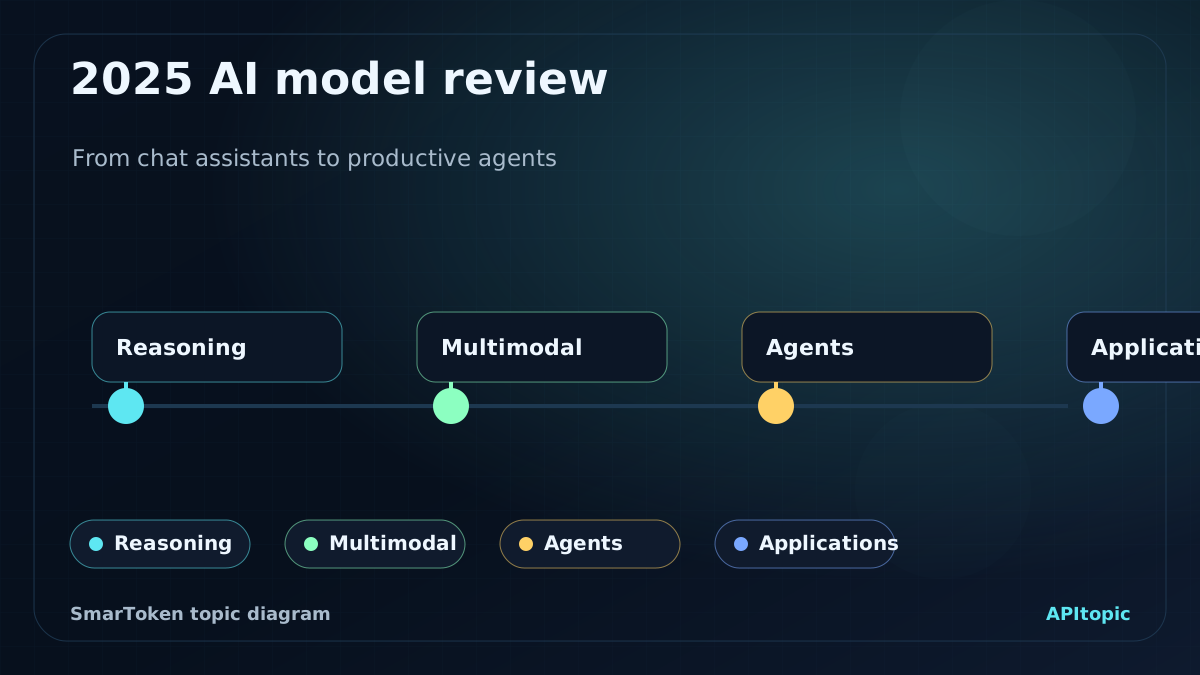
SmarToken editorial diagram for 2025 AI model review: Reasoning, Multimodal, Agents, Applications.
SmarToken diagram showing how 2025 model updates shifted from single-chat use toward reasoning, multimodal input and agent work.
  • Reasoning became a normal expectation rather than a premium novelty.
  • Long context became useful for reports, codebases and large reference packets.
  • Agentic work changed the question from 'what can it say' to 'what can it finish'.
2025 shiftWhat this page observedHow to test it
ReasoningModels handled harder logic and math-style tasks.Use checkable prompts with known failure modes.
MultimodalImage and visual context became part of normal evaluation.Ask for grounded interpretation, not generic captioning.
Agent workModels began to plan and act across tools.Score completed tasks, not only one response.

The review's method is more useful than the leaderboard

The analysis uses practical task categories instead of relying only on public benchmark names. That makes the analysis useful as a test design, even if readers do not accept every score.

The evaluation runs models through several pressure points: hallucination and fact checking, complex logic, multimodal understanding, creative business ideas and coding or web-building tasks. This is a better editorial structure than a pure leaderboard because it shows where models break. A model can be strong at creative framing and still weak at strict fact checking. Another can produce polished UI but fail on interaction details. Those task-specific gaps are exactly what product teams need to see.

  • Fact checking tests whether the model refuses to invent details.
  • Logic tasks test whether the model can avoid shortcut reasoning.
  • Coding tasks test whether the model can turn requirements into working structure.

Hallucination testing became stricter

The hallucination test asks models to identify real and fake product names, output JSON and avoid inventing parameters for nonexistent products.

This is a strong test because it combines retrieval, caution and formatting. A weak model may know enough to sound convincing, then still invent a model name, parameter count or release date. A useful production model has to do something less glamorous: say when a claim is unsupported. Keep that lesson visible. In real work, hallucination control is often more valuable than an impressive answer.

  • Require structured output.
  • Include fake or mixed product names.
  • Penalize invented details, not only wrong conclusions.

Multimodal and creative tests separate taste from capability

The analysis uses visual interpretation and creative product ideation to show that high-end models are now judged on judgment, tone and context, not only factual recall.

The creative test is intentionally subjective, but still useful. It asks whether a model can understand an emotional problem, create a plausible product idea and explain it in a way humans might care about. The multimodal test asks whether visual details are actually grounded. These tasks reveal a different kind of quality: concept control, taste, restraint and the ability to connect details into a useful answer.

  • Creative scoring should explain why an idea works, not only assign stars.
  • Visual tests should check grounding and omissions.
  • Subjective tasks still need clear criteria.

Coding tests show the gap between demo output and production work

The coding cases show why model evaluation should inspect structure, polish, interaction and requirement coverage instead of asking whether the model produced any code at all.

Several models can now create a plausible single-page site from a prompt. The difference is in execution: information hierarchy, responsive behavior, motion restraint, interaction details and whether the result matches the requested style. That turns the coding review into a repeatable scoring pattern. A useful coding model should complete the requested surface, preserve constraints and leave code that can be revised.

  • Check whether every requested section exists.
  • Check interaction quality and visual consistency.
  • Score code structure and maintainability, not only screenshots.

A reusable test pattern

Readers should copy the review's task mix: fact checking, logic, multimodal reading, creative planning and coding. They should not blindly copy the final ranking.

The recommendations are valuable as a dated 2025 snapshot. But the durable asset is the testing pattern. If a team is choosing a route in 2026, it should build a small prompt pack with the same categories and run it against the models it can actually call. That makes the analysis useful beyond its publication window.

  • Use the review as a prompt-pack template.
  • Keep model recommendations dated.
  • Retest after major releases or route changes.

Common mistakes to avoid

Mistake

Treating one article as a final ranking

Why it hurts

Model releases, pricing, quotas and benchmark positions can change quickly.

Better move

Use the analysis as a shortlist, then run current checks against your own workload.

Mistake

Choosing by brand instead of task

Why it hurts

A strong chat model may still be weak for long documents, coding agents, multimodal work or low-latency routes.

Better move

Define the job first, then compare models with prompts, files or media that match that job.

Mistake

Copying claims without a current verification check

Why it hurts

Benchmark numbers, context windows, API names and prices may be dated or provider-specific.

Better move

Confirm high-impact details against official docs, model cards or live provider pages.

Read it as a model briefing, not a setup guide

View model catalog ->

Use this page to understand the model family, the evaluation angle and the current conversation around it. Then choose one or two realistic prompts, documents or media tasks and test whether the model behaves well in your own workflow.

FAQ

These questions reflect recurring reader concerns around Chinese model knowledge, evaluation and fast-moving model releases.

What is the main point of 2025 AI model annual review: from chat assistants to productivity agents?

The central point is that 2025 was the year large models moved from text assistants toward productivity agents. Reasoning became normal, long context became a basic expectation, native multimodal models replaced stitched-together toolchains, and real tests shifted from benchmark trivia to work-like tasks such as fact checking, logic, visual understanding, creative planning and code generation.

How should readers use the Chinese model context here?

Use it as market and product context, then verify technical claims, pricing, quotas and release details against official pages or your own tests before making a decision.

Why is there a short video with the page?

The video gives a fast visual summary of the model story, while the written page carries the caveats, comparisons and practical checks.

References and verification

SmarToken tracks public model releases, technical reports, product announcements and market signals to keep this catalog useful.

Technical claims need to be treated as dated unless they are confirmed by current official model cards, technical reports or provider announcements.

Pricing, quota, availability and benchmark details can change after the review date, so production decisions should use current vendor pages and direct workload tests.

Get API Key